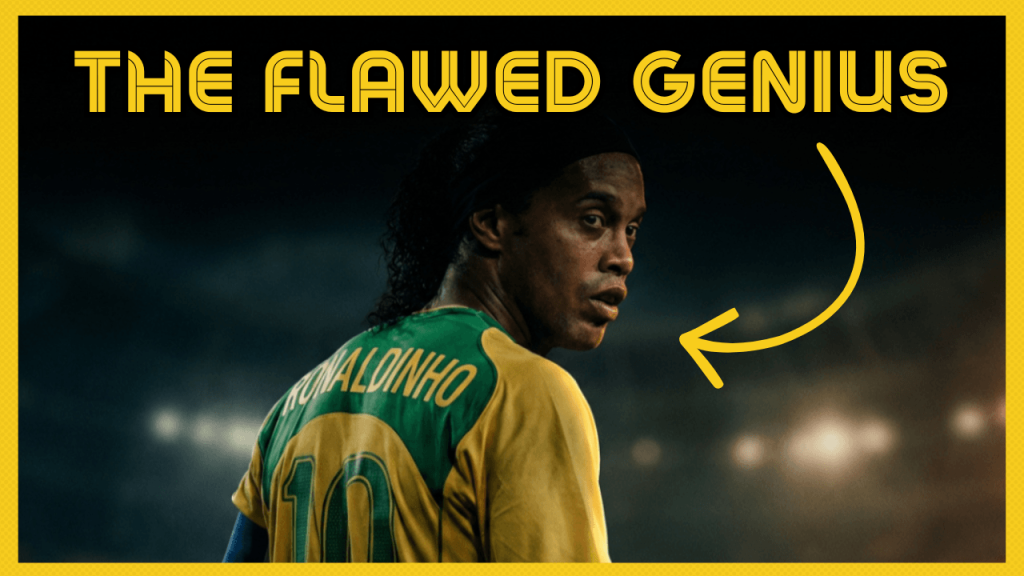
Ronaldinho: O Bruxo, The Wizard Who Changed Football, Earned a Standing Ovation at the Bernabéu, and Ended Up in a Paraguayan Prison
He grew up in Porto Alegre playing futsal on the streets, lost his father in a swimming pool accident when he was eight years old, scored 23 goals in a single youth match at thirteen, and became, between 2004 and 2006, the most electrifying footballer on the planet. He starred in the first YouTube video ever to reach one million views. He made Real Madrid fans stand up and applaud him at the Bernabéu. He won the 2002 World Cup, two FIFA World Player of the Year awards, a Ballon d’Or, the Champions League, and a Copa Libertadores, the only player in history to complete that exact set. Then, at the height of his fame, he gradually stopped caring about training, chose parties over preparation, and allowed one of the most astonishing careers in football history to dissolve into an afterword of faded stints and, ultimately, a 32-day spell in a Paraguayan maximum-security prison over a falsified passport.
This is the full story of Ronaldinho, O Bruxo, the Wizard. The man who played football as if the game existed purely for the joy of it, which was, for two extraordinary seasons, the truest and most complete expression of football’s possibilities, and simultaneously the personality trait that eventually undid everything he had built.
Watch the Ronaldinho Documentary
Ronaldinho Gaucho: The Life and Career of O Bruxo
Key Facts
Quick context before you watch:
- Full Name: Ronaldo de Assis Moreira. Born 21 March 1980, Porto Alegre, Rio Grande do Sul, Brazil. Known as Ronaldinho or Ronaldinho Gaúcho.
- Nicknames: Ronaldinho (“Little Ronaldo”, given as a youth because he was the smallest player); O Bruxo (“The Wizard”).
- Position: Attacking midfielder / left winger.
- Father: João de Assis Moreira, shipyard worker and local footballer, drowned in a swimming pool accident when Ronaldinho was eight years old.
- Career Clubs: Grêmio → Paris Saint-Germain → FC Barcelona → AC Milan → Flamengo → Atlético Mineiro → Querétaro (Mexico) → Fluminense. Officially retired 2018.
- International: 97 caps, 33 goals for Brazil (1999 to 2013).
- Major honours: FIFA World Cup 2002 (Brazil) | Copa América 1999 (Brazil) | FIFA Confederations Cup 2005 (Brazil) | UEFA Champions League 2005-06 (Barcelona) | Copa Libertadores 2013 (Atlético Mineiro) | La Liga: 2004-05, 2005-06 (Barcelona) | Serie A: 2010-11 (AC Milan)
- Individual Awards: FIFA World Player of the Year 2004, 2005 | Ballon d’Or 2005 | UEFA Club Footballer of the Year 2005-06 | South American Footballer of the Year 2013 | Named in Pelé’s FIFA 100 list (2004)
- Unique Distinction: The only player in history to have won a World Cup, a Copa América, a Confederations Cup, a Champions League, a Copa Libertadores, and a Ballon d’Or.
- Nike Crossbar Challenge Video (October 2005): the first YouTube video ever to reach one million views.
- 2020: arrested in Paraguay after entering the country with falsified passports. Spent 32 days in maximum-security prison, then five months under hotel house arrest. Released August 2020 after paying $90,000 in fines.
Watch the Ronaldinho Documentary
Ronaldinho Gaucho: The Life and Career of O Bruxo
Porto Alegre: Futsal, Tragedy and the Boy Called Little Ronaldo
Ronaldo de Assis Moreira was born on 21 March 1980 in Porto Alegre, the capital of Rio Grande do Sul in southern Brazil, a city defined by its twin football clubs, Grêmio and Internacional, whose rivalry has shaped the city’s social geography for over a century. He came from a football family: his father, João, had played for a local club while working as a welder in the shipyards, and his brother Roberto, nine years his senior, would sign for Grêmio and turn professional. The sport was not a hobby in the Moreira household. It was the language the family spoke.
He was not yet playing organised football (just street football, beach football, futsal on the courts of Porto Alegre) but from the beginning he was among the youngest and smallest wherever he played. His teammates called him Ronaldinho, the diminutive of his birth name Ronaldo, because he was always the little one, always the youngest, always the kid who had no business keeping up with the older boys and kept up with them anyway. The nickname stayed for the rest of his life.
When Roberto signed for Grêmio, the club provided the family with a house in the more affluent Guarujá district of Porto Alegre, a standard practice for Brazilian clubs trying to secure promising players’ loyalty. The house had a swimming pool. Shortly after the family moved in, João de Assis Moreira slipped, hit his head, and drowned. He was forty-one years old. Ronaldinho was eight.
He would later describe his father as one of the most important people in his life, despite having only eight years with him. His father had given him advice both on and off the pitch that he carried into adulthood: off the pitch, ‘Do the right thing and be an honest, straight-up guy’; on it, ‘Play football as simply as possible.’ He would say his father taught him that one of the most complicated things you can do in football is to play it simple. Whether Ronaldinho ever fully absorbed that second piece of advice is an open question. What is not open to question is that he inherited his father’s love of the game completely, and built it into something his father could never have predicted.
Roberto’s own playing career was subsequently cut short by injury, closing a door that had looked so promising. Their mother, Miguelina, who had been studying to become a nurse, continued working. The family structure held. And Ronaldinho continued playing, on the futsal courts of Porto Alegre, where the close-quarter demands of the small-sided game were forging the ball control, the quick footwork, the instinct for the impossible pass and the unexpected turn that would one day produce a standing ovation at the Santiago Bernabéu.
At thirteen, he scored 23 goals in a single match for his youth team, a result so extraordinary it made the Brazilian press. It was a sign, if one were needed, that this was not an ordinary child.
Grêmio: First Steps and the U-17 World Cup
In 1997, aged seventeen, Ronaldinho received his first call-up for the Brazil Under-17 national team. They travelled to Egypt for the FIFA Under-17 World Championship, and won it. Ronaldinho was named the tournament’s best player, collecting the Golden Ball. Major European clubs began paying attention. Shortly afterwards, he signed his first professional contract with Grêmio, the club his brother Roberto had also served.
He made his senior debut for Grêmio in the 1998 Copa Libertadores, barely eighteen years old, already playing with a confidence and creativity that defied explanation by age or experience. In 1999, called up to the senior Brazil squad for the Confederations Cup in Mexico, he scored four goals and won the Golden Ball as the tournament’s best player, while Brazil finished second. He was nineteen. That same year, Brazil won the Copa América, Ronaldinho’s first senior international honour.
In 2001, Grêmio were relegated from the Brazilian top flight. Ronaldinho, whose contract was expiring, was already being linked with a move to Europe. Arsenal were very close to signing him, but the deal collapsed because he did not yet have enough international caps to qualify for a UK work permit, a bureaucratic technicality that would redirect the remainder of his career. The transfer that changed everything went instead to Paris Saint-Germain, who signed him for approximately €5 million.
Watch the Ronaldinho Documentary
Ronaldinho Gaucho: The Life and Career of O Bruxo
PSG: Europe and a Transfer That Almost Went to Manchester United
Paris agreed with Ronaldinho in more ways than one. The city’s social life suited his personality as much as the football suited his ability. In his first season, he scored 13 goals and provided 7 assists in 40 appearances, excellent numbers for a teenager finding his feet in a new country and league. In 2001, PSG also won the UEFA Intertoto Cup, a modest honour, but Ronaldinho’s first club trophy as a professional. PSG gave him the number 10 shirt for his second season.
His coach Luis Fernandez, however, had reservations that went beyond results. Fernandez would later write in his memoirs that Ronaldinho lacked tactical discipline and was ‘very fond of partying’, that ‘women were brought into the room during team gatherings.’ These were early signals of the personality that would, years later, unravel everything at Barcelona. In Paris, the talent more than compensated. At Barcelona, the party would eventually consume the genius.
After Brazil won the 2002 World Cup (more on that in the next section) Ronaldinho returned to PSG as a man who had announced himself to the world on the biggest stage. Manchester United wanted him. Sir Alex Ferguson was direct: he wanted Ronaldinho to be the new face of Old Trafford as David Beckham headed to Madrid. The deal was close. Then Sandro Rosell, later Barcelona president, reminded Ronaldinho of a conversation they had held before the World Cup: ‘If I become Barca president, will you come?’ Ronaldinho had said yes. When the moment came, that prior commitment held. ‘It was a matter of 48 hours,’ Ronaldinho later confirmed.
Barcelona paid €30 million, the heaviest investment they could afford while heavily in debt. It proved to be the most consequential €30 million in the club’s modern history.
The 2002 World Cup: Seaman, the Free Kick and the Red Card
The 2002 World Cup in Japan and South Korea was Ronaldinho’s global introduction. Brazil arrived with a trio of attackers at their creative centre (Ronaldo, Rivaldo, and Ronaldinho) known collectively as the Three Rs. Ronaldinho was the youngest of the three, just twenty-two, and only a year into his European career. He was not yet known to most English audiences.
On 21 June 2002, in the quarter-final at Shizuoka, England faced Brazil in the match that England fans have revisited through gritted teeth ever since. Michael Owen capitalised on a Lucio error to put England ahead in the 23rd minute. Then, just before half-time, Brazil equalised in stunning fashion. Kleberson won the ball in midfield and fed it to Ronaldinho, who drove forward and beat Ashley Cole with a stepover so complete it left the defender pointing in the wrong direction. Free in the inside-left channel, Ronaldinho slipped a first-time pass through to Rivaldo, who finished clinically. Brazil level at 1-1.
Early in the second half, Brazil won a free kick wide on the right, approximately 35 yards from goal. Nobody in England’s defensive arrangement accounted for the possibility that Ronaldinho might shoot.
The ball left his boot in the 50th minute with a trajectory that suggested a cross into the box. Then it kept rising and dipping, bending in a way that seemed to contradict the physics of a ball struck that hard from that far. David Seaman, England’s veteran goalkeeper, was still backpedalling as it sailed over his head and settled in the top of the net.
The debate over intent has never fully been resolved. Beckham called it a fluke. Danny Mills said Rio Ferdinand had asked Ronaldinho after the game if he meant it, and ‘his sheepishness suggests to me it was a misguided cross.’ Ronaldinho himself has given different answers at different times. The most candid version: ‘When I hit the ball I wanted to shoot for goal, but maybe not exactly where the ball ended up. I was aiming for the other side of the net. There was an element of luck. But no, you can’t say it was a fluke, because I was aware of the keeper’s position and went for the shot at goal.’
Brazil 2-1 England. Twenty minutes later, Ronaldinho was sent off for a foul on Mills, a red card many observers considered harsh. England, with a man advantage for the final half hour, could not score. Brazil went on to beat Germany 2-0 in the final. Ronaldinho had his World Cup winner’s medal. He was twenty-two years old.
Barcelona: The Arrival of O Bruxo
Barcelona in the summer of 2003 were not the club they would become. They had not won La Liga since 1999. They were financially distressed. The Galáctico policy at Real Madrid (Zidane, Figo, Beckham, Ronaldo) had redrawn the power map, and Barça were watching. Frank Rijkaard had just been appointed coach, beginning a project built on possession, technique, and freedom of expression. Into this rebuilt squad, in the summer of 2003, came Ronaldinho.
His debut was against Sevilla, a Wednesday night game that stretched past midnight in typical Barcelona fashion, and he immediately did things the Camp Nou had not seen in some time. A scooped pass. A stepover that stopped a defender dead. A free kick that bent against the apparent grain of physics. Carles Puyol, Barcelona’s captain, would later say: ‘The greatest compliment I could give him is that he’s given Barcelona our spirit back. He has made us smile again.’
The 2003-04 season was a settling-in year. Barcelona finished second in La Liga, but the pieces were assembling. Ronaldinho scored 15 league goals, and in April 2004 his scooped through-ball set up the winning goal for Xavi in a 2-1 away win at the Santiago Bernabéu, Barcelona’s first victory there in seven years. Xavi would later identify that result as the beginning of ‘the Barcelona rise.’ The following season, everything clicked.
In 2004-05, Barcelona won La Liga for the first time in six years. Ronaldinho was named FIFA World Player of the Year in December 2004. He was twenty-four years old, playing in the best team in Europe alongside Eto’o, Deco, and Iniesta, with a seventeen-year-old Lionel Messi making his senior debut in October 2004 and beginning to emerge from the shadows of La Masia. Ronaldinho was the undisputed best player in the world. And in November 2005, he gave football a moment it had never seen before and has not seen since.
Watch the Ronaldinho Documentary
Ronaldinho Gaucho: The Life and Career of O Bruxo
The Bernabéu Ovation: 19 November 2005
It is one of the most singular events in El Clásico history, perhaps in the history of football rivalry at any level: a visiting player received a standing ovation from the home fans of their most bitter rivals after dismantling their team with two goals and a 90-minute masterclass.
The match was played on 19 November 2005 at the Santiago Bernabéu. Barcelona were leading La Liga; Real Madrid had begun the season poorly. The atmosphere was febrile from the first whistle, and it was immediately apparent that Ronaldinho had decided this was his night.
Eto’o put Barcelona ahead after 15 minutes. Throughout the first half, Ronaldinho had already made Sergio Ramos (nineteen years old, recently arrived from Sevilla, undoubtedly talented but still finding his feet at the top level) look comprehensively inadequate. Then Ronaldinho scored the second. He received the ball on the left, skipped inside Ramos’s challenge, jinked past Ivan Helguera with a shimmy that left the experienced defender rooted to the spot, and finished past Iker Casillas. Real Madrid’s goalkeeper simply shook his head.
His third major contribution (Ronaldinho’s second, which made it 3-0) involved an elastico at pace that seemed to belong in a different category of sport entirely, a feint so total that it left defenders pointing in different directions while Ronaldinho rolled the ball into the corner.
As he walked away from each celebration, something unprecedented was building in the stands. First one by one, then in larger and larger groups, Real Madrid fans rose and began to applaud. It grew until it was the whole stadium, the sound of 80,000 people acknowledging that what they were watching was beyond rivalry, beyond club loyalty. It was football at a level that demanded recognition from anyone who understood the game.
Only one Barcelona player before him had received that honour at the Bernabéu: Diego Maradona, in 1983.
Ronaldinho said afterwards: ‘Few players have had this happiness, in a Clásico, the fans of your biggest rival applaud you. Few have had this happiness.’ Real Madrid’s defender Ivan Helguera described it as ‘the most painful defeat I’ve experienced at Real. There are no excuses, we gave a poor display and our fans ended up cheering the opposition.’ Eto’o, watching from close range, could barely process what he had witnessed: ‘I stood there in disbelief and muttered to myself: “What is happening?”‘
The 2005 Ballon d’Or, the Champions League Final, and the Peak
In December 2005, Ronaldinho collected the Ballon d’Or, awarded for his performances during the 2004-05 season, which had been by any measure the finest sustained individual campaign the game had seen in years. He was also UEFA Club Footballer of the Year for 2005-06, and twice FIFA World Player of the Year. In the space of two seasons he had accumulated every individual honour the game could offer.
The 2005-06 season was his absolute zenith as a team player. Barcelona’s Champions League campaign was built around the attacking triad of Ronaldinho, Samuel Eto’o, and Messi, who had turned eighteen and was beginning to take his first irreversible steps as a world-class figure. They were too much for Werder Bremen, Udinese, and Panathinaikos in the group stage, beat Chelsea across two legs in the round of sixteen, avenging their elimination of the previous year, and reached the final at the Stade de France in Paris on 17 May 2006.
Their opponents were Arsenal, who arrived having set a then-record of 995 consecutive minutes without conceding a goal in the competition. Arsenal’s goalkeeper Jens Lehmann was sent off in the 18th minute for bringing down Eto’o. Despite their numerical disadvantage, Arsenal took the lead through Sol Campbell’s header on 37 minutes, and held it into the final quarter of the game. Then Rijkaard made a substitution that has passed into Champions League legend: Henrik Larsson, thirty-four years old, came on for Mark van Bommel in the 61st minute.
The rest of the game belonged to Larsson. In the 76th minute, Iniesta played the ball to Larsson on the left; his deft one-touch lay-off released Eto’o to fire past Almunia at the near post and equalise. Four minutes later, Larsson played a one-two with Belletti in the right channel, and the substitute full-back shot right-footed through Almunia’s legs to score the winner. Barcelona 2-1 Arsenal.
Thierry Henry, Arsenal’s captain, was magnanimous and precise in equal measure afterwards: ‘People always talk about Ronaldinho, Eto’o, Giuly and everything, but I didn’t see them today, I saw Henrik Larsson. He came on and he changed the game. That is what killed the game. Sometimes you talk about Ronaldinho and Eto’o and people like that; you need to talk about the proper footballer who made the difference, and that was Henrik Larsson tonight.’
Henry’s tribute was a compliment to Larsson and an inadvertent commentary on Ronaldinho’s performance, one of the stranger footnotes to his greatest season. He won the double. He was the best player in the world. His team-mate’s last act for the club outshone him in the final of the Champions League. Ronaldinho would never win it again.
The 2006 World Cup was next. Everyone expected Brazil to deliver the most gloriously entertaining football the tournament had ever seen. What happened instead was the beginning of the end.
The Fall: Parties, Passivity and the End of an Era
The 2006 World Cup in Germany should have been the confirmation of everything. Brazil’s much-publicised ‘magic quartet’ of Ronaldinho, Ronaldo, Adriano, and Kaká was the centrepiece of Nike’s Joga Bonito advertising campaign, a global exercise in the idea that Brazil were about to produce the most beautiful football the World Cup had ever seen. Ronaldinho played in all five of Brazil’s matches. He was passive, disengaged, a ghost of the player who had conquered the Bernabéu six months earlier.
On 1 July 2006, in the quarter-final in Frankfurt, Brazil went out to France 1-0. Thierry Henry scored from a Zidane free kick in the 57th minute. Roberto Carlos had bent down to tie his laces as Zidane prepared to deliver the ball, leaving Henry entirely unmarked at the far post. It was a measure of Brazil’s torpor throughout the tournament that even that detail, the surreal sight of a full-back retying his boots during an opposition free kick, barely caused surprise.
The statue of Ronaldinho in Porto Alegre, erected in 2004 to celebrate his first FIFA World Player of the Year award, was defaced by angry fans that same day. That same night, Ronaldinho and Adriano returned to Barcelona, held a party at Ronaldinho’s home, and continued into the early hours at a nightclub. The optics were catastrophic. Brazilian fans who had expected their team to challenge for the trophy and received instead a disconnected, disinterested quarter-final exit watched their supposed leader party through the disappointment as if it were just another evening.
The football writer Tostão, a member of Brazil’s legendary 1970 World Cup squad, identified precisely what was missing: ‘Ronaldinho lacks an important characteristic of Maradona and Pelé: aggression. They transformed themselves in adversity. They became possessed, and furious.’ Ronaldinho, by contrast, coasted when things were difficult, saving his brilliance for the matches where he felt like performing. The party was the clearest possible expression of that personality.
Back at Barcelona, the decline became visible and then undeniable. He asked to be excused from the 2007 Copa América due to fatigue. In October 2007, he was benched by Barcelona after returning late to Spain following a 5-0 friendly win over Ecuador, he and several Brazil teammates had partied through the night in Rio, and he had allegedly left the following morning in the boot of a car to avoid the press. Barcelona president Joan Laporta issued a public warning, calling on Ronaldinho to understand that professionalism required more than playing well on Sundays.
The warnings were not absorbed. He went nearly two years without scoring for Brazil. His physical condition deteriorated; once explosive, he became laboured. When Pep Guardiola was appointed Barcelona head coach in the summer of 2008, the decision was made quickly: Ronaldinho was not part of the future. He was sold to AC Milan for €21 million in August 2008. Carlo Ancelotti, who signed him at Milan, was philosophical: ‘The decline of Ronaldinho hasn’t surprised me. His physical condition has always been very precarious. His talent though has never been in question.’
The Return: AC Milan, Flamengo and the Copa Libertadores Redemption
What followed Barcelona was, by most measures, an extended afterword. But it contained one genuinely remarkable chapter.
At AC Milan, flashes of the old brilliance remained. He scored on his debut in a Milan derby against Inter. He finished his first season with 10 goals in 32 appearances. But fitness and commitment remained inconsistent, and Ancelotti’s successors grew frustrated. One episode reported in Italian media, Ronaldinho being escorted from a Milan nightclub back to his home by fans the night before a major match, became symbolic of a man who could no longer draw the line between his footballing life and his social one.
He returned to Brazil in January 2011, signing for Flamengo to a reception from more than 20,000 fans at his unveiling. The homecoming was warm, but Flamengo were unable to retain him for long. A year later, in a decision that would produce the most unexpected chapter of his career, he joined Atlético Mineiro in Belo Horizonte.
What happened between 2012 and 2013 at Atlético Mineiro was the closest thing Ronaldinho ever produced to a second act. He rediscovered form, joy, and the ability to decide matches when it mattered. He won the Brazilian Golden Ball for 2012. He helped the club to the Campeonato Mineiro. And then, in 2013, he played his part in Atlético Mineiro winning the Copa Libertadores, the first Copa Libertadores in the club’s ninety-year history. He was thirty-three years old. He contributed four goals and seven assists across the campaign. He was named South American Footballer of the Year.
The Copa Libertadores title completed something that had never been achieved before and has not been matched since. Ronaldinho had now won a World Cup (Brazil, 2002), a Copa América (Brazil, 1999), a Confederations Cup (Brazil, 2005), a Champions League (Barcelona, 2006), a Ballon d’Or (2005), and a Copa Libertadores (Atlético Mineiro, 2013). No player in the history of football has won all six of those trophies. He holds that distinction alone, and the fact that he had to wait until the age of thirty-three, at a club that had never previously won the competition, to complete the set is entirely in keeping with the particular arc of his career.
After Atlético Mineiro he played a season for Querétaro in Mexico from 2014 and returned to Brazil with Fluminense in 2015. He officially retired in 2018, aged thirty-seven.
Watch the Ronaldinho Documentary
Ronaldinho Gaucho: The Life and Career of O Bruxo
The Crossbar, the Smile and the Internet
There is a video, made in 2005 for Nike, that captures something essential about what Ronaldinho was at his peak. In it, he receives a gold briefcase (dispatched by Eric Cantona, naturally) containing a pair of Nike Tiempo boots in gold and white. He laces them up, walks onto an empty pitch, and begins doing kick-ups as he strolls toward goal. Then, from outside the box, still performing kick-ups without the ball touching the ground, he launches it at the crossbar. It comes back. He controls it on his chest and strikes the bar again. It comes back. He does it a third time. Three consecutive rebounds, the ball never touching the ground.
Posted on YouTube on 20 October 2005, it became the first video in the platform’s brief history to reach one million views, a record achieved just eight months after YouTube was founded. Whether the footage was genuine has been debated ever since; Nike eventually confirmed it had been edited. The debate itself, however, was the entire point. Ronaldinho was the only player where the question ‘could he actually do that?’ was one a reasonable person would ask in all seriousness.
The same quality that made the crossbar video plausible was what made the Bernabéu ovation inevitable. Ronaldinho did not simply do skilful things, he did things that made watching football feel like watching a different discipline from the one you thought you understood. The smile was real. The joy was real. In his peak years, he made the game feel like it existed not because of competition or economics or tactics but because playing football brilliantly was one of the finer things a human being could do with their time.
He was the face of Nike’s Joga Bonito campaign. He appeared on the cover of six consecutive editions of the FIFA video game between 2004 and 2009. He featured in the 2002 ‘Secret Tournament’ commercial directed by Terry Gilliam. He earned over $19 million in endorsements alone in 2006. In 2011, he signed a deal with Coca-Cola. Months later, he was photographed drinking Pepsi at a press conference; the Coca-Cola deal was terminated immediately. It was entirely Ronaldinho: charming, careless, and completely impossible to be angry with.
Paraguay, Prison and the Long Goodbye
The years after his retirement in 2018 brought a different kind of notoriety.
In the years preceding the Paraguay episode, Ronaldinho had accumulated significant financial difficulties. His Brazilian and Spanish passports had been confiscated by Brazilian authorities in July 2019 over unpaid tax debts and an investigation into alleged environmental crimes at a property in Brazil. He recovered his documents in September 2019 and continued travelling internationally for promotional commitments.
On 4 March 2020, Ronaldinho and his brother Roberto arrived in Paraguay. The visit was intended to be promotional, an event supporting disadvantaged children. At Silvio Pettirossi Airport in Asunción, they presented Paraguayan passports. The passports were authentic documents (real, with valid serial numbers) but the personal details they contained were false, belonging to other people. Paraguayan authorities arrested the brothers on 6 March, two days after their arrival, after a raid on their hotel.
They were held in the Agrupación Especializada, a maximum-security prison in Asunción housing approximately 150 inmates convicted of drug trafficking, corruption, and violent crime. They celebrated Ronaldinho’s 40th birthday in the prison on 21 March 2020. Videos circulated of him playing football in the prison yard with fellow inmates, of course they did. Ronaldinho could not stop playing football. He had never been able to stop.
After 32 days, they were moved to house arrest at a luxury hotel in Asunción in April 2020, following the payment of $800,000 each in bail. They remained in Paraguay for five months in total. Prosecutors ultimately concluded that Ronaldinho had been deceived, that a Brazilian businessman, Wilmondes Sousa Lira, had provided the false documents without Ronaldinho’s full understanding that they were illegal. His brother Roberto was considered more culpable. In August 2020, both pleaded guilty. Ronaldinho paid a fine of $90,000 and left Paraguay with no criminal record; his brother paid $110,000 and was barred from leaving Brazil for two years.
‘I never imagined that I would go through something like this,’ Ronaldinho told Paraguayan newspaper ABC Color from his hotel. ‘All my life I have tried to be as professional as possible and bring joy to people with my football.’ The tone was recognisable, the Ronaldinho cadence, earnest and slightly bewildered, the same man who had once played football in a prison yard as though the concrete walls were the least remarkable thing about the situation.
Since his release, he has remained in Brazil, participating in charity and exhibition matches. In 2025, his son João Mendes de Assis Moreira signed for FC Barcelona’s youth academy, a different kind of Ronaldinho at the Camp Nou, but a Ronaldinho at the Camp Nou nonetheless.
Legacy: Why Ronaldinho Still Matters
There is a version of Ronaldinho’s legacy that focuses on what he did not achieve, the career he might have had if the dedication had matched the talent, the World Cups he did not win after 2002, the years at Barcelona that could have been five more rather than the two at the absolute peak. That version is real. It is not the whole story.
The fuller version starts with what he actually did: he arrived at Barcelona when the club was drifting in the shadow of the Galácticos and gave them their spirit back, then their titles, then the Champions League. He made a Real Madrid crowd applaud him. He won every major trophy the game could offer. And he did all of it with a joy and an inventiveness that made football feel genuinely alive in a way that even the most accomplished players rarely manage to sustain for more than a moment.
There is also the matter of influence. Lionel Messi, who made his senior Barça debut while Ronaldinho was still the club’s leading light, has spoken about watching Ronaldinho train every day as a formative experience, about the way he would casually produce in training what other players could not produce in their finest competitive performances. Neymar has cited him as the player above all others who made him want to play. Kevin de Bruyne, who describes Ronaldinho as his footballing idol, has talked about watching the Bernabéu footage as a teenager and deciding that this was what playing football was supposed to look like. He was not just a footballer; he was a proof of concept, evidence that total technical freedom and total competitive effectiveness were not in tension but were in fact the same thing, expressed correctly.
The crossbar video. The Bernabéu ovation. The free kick over Seaman. The Copa Libertadores at thirty-three, completing a trophy collection nobody else has ever assembled. The prison football in Asunción. The smile, always the smile, in every conceivable circumstance, in every possible situation. Ronaldinho lived his contradictions at full volume. That the story does not have a tidy ending is entirely in keeping with him. He was never, in any sense, a tidy player.
Watch the Ronaldinho Documentary
Ronaldinho Gaucho: The Life and Career of O Bruxo
Frequently Asked Questions (FAQs)
Who is Ronaldinho and why is he considered one of the greatest footballers of all time?
Ronaldinho (full name Ronaldo de Assis Moreira, born in Porto Alegre, Brazil in 1980) is widely considered one of the greatest footballers in the history of the sport. He is the only player ever to have won a FIFA World Cup, a Copa América, a FIFA Confederations Cup, a UEFA Champions League, a Copa Libertadores, and a Ballon d’Or. He won two FIFA World Player of the Year awards in 2004 and 2005, and was named in Pelé’s FIFA 100 list of the greatest living footballers in 2004. At his peak with FC Barcelona between 2004 and 2006, he was the undisputed best player in the world, combining extraordinary technical skill, creativity, and an infectious joy that made him a global icon beyond football.
What was Ronaldinho’s famous goal against England at the 2002 World Cup?
On 21 June 2002, in the World Cup quarter-final in Shizuoka, Japan, Ronaldinho scored one of the most debated goals in tournament history. With Brazil and England level at 1-1 early in the second half, Brazil won a free kick wide on the right, roughly 35 yards from goal. In the 50th minute, rather than crossing into the area as everyone expected, Ronaldinho floated the ball over the head of England goalkeeper David Seaman, who was still backpedalling when it went in. Whether it was a deliberate shot or a mishit cross remains contested. Ronaldinho himself acknowledged an element of luck while insisting he was aiming at goal. Brazil won 2-1, despite Ronaldinho’s subsequent red card, and went on to win the World Cup final against Germany.
Why did Real Madrid fans give Ronaldinho a standing ovation at the Bernabéu?
On 19 November 2005, Barcelona visited Real Madrid’s Santiago Bernabéu stadium for El Clásico and won 3-0. Ronaldinho scored two extraordinary goals, both involving sequences that left experienced Real Madrid defenders stationary, and was involved in practically everything Barcelona did well for 90 minutes. As he celebrated his second goal, Real Madrid supporters began to rise to their feet and applaud. The ovation grew until it encompassed the entire stadium. Only Diego Maradona, in 1983, had previously received such recognition from Real Madrid fans. Ronaldinho later said: ‘Few players have had this happiness, in a Clásico, the fans of your biggest rival applaud you. Few have had this happiness.’
What unique trophy distinction does Ronaldinho hold in football history?
Ronaldinho is the only player in football history to have won a FIFA World Cup, a Copa América, a FIFA Confederations Cup, a UEFA Champions League, a Copa Libertadores, and a Ballon d’Or. Each individual trophy has been won by many players, but no one else has won all six. The final piece, the Copa Libertadores, came in 2013 with Atlético Mineiro, when Ronaldinho was thirty-three years old, at a club that had never previously won the competition. That it took until that point, at that club, in those circumstances, to complete the set is a story in itself.
Why did Ronaldinho decline so quickly after his peak at Barcelona?
Ronaldinho’s decline after 2006 is widely attributed to a loss of dedication and discipline, manifested through a lifestyle of late-night partying, missed or poor training sessions, and a failure to maintain the physical conditioning that elite football demands. The 2006 World Cup, where Brazil’s highly publicised ‘magic quartet’ produced a passive, disconnected campaign and went out to France in the quarter-final, was the visible turning point. Ronaldinho partied the night of the defeat; he went nearly two years without scoring for Brazil; he was benched by Barcelona for returning late from a night out in Rio. His physical sharpness deteriorated. When Pep Guardiola became Barcelona’s coach in 2008, Ronaldinho was sold to AC Milan. Carlo Ancelotti, who signed him at Milan, observed: ‘The decline of Ronaldinho hasn’t surprised me. His physical condition has always been very precarious. His talent though has never been in question.’
What happened to Ronaldinho in Paraguay in 2020?
In March 2020, Ronaldinho and his brother Roberto arrived in Paraguay for a promotional event and presented Paraguayan passports containing false personal details, real documents, but with fraudulent information that belonged to other individuals. They were arrested on 6 March and spent 32 days in the Agrupación Especializada, a maximum-security prison in Asunción. After paying bail of $800,000 each, they were transferred to hotel house arrest for a further four months. In August 2020, both pleaded guilty. Ronaldinho paid a $90,000 fine and was released with no criminal record in Paraguay; his brother Roberto received a more significant penalty. Prosecutors concluded that Ronaldinho had most likely been deceived about the nature of the documents.
How many goals did Ronaldinho score for FC Barcelona?
Ronaldinho scored 98 goals in 207 appearances for FC Barcelona between 2003 and 2008, according to the club’s official records. He was the central figure in one of the most celebrated periods in the club’s modern history, winning two consecutive La Liga titles in 2004-05 and 2005-06, and the UEFA Champions League in 2005-06. His time at the club ended with two difficult final seasons marked by declining form and fitness, and a €21 million sale to AC Milan in August 2008 as Guardiola rebuilt the squad around the emerging generation led by Lionel Messi.
What was the Nike crossbar challenge video, and why was it historically significant?
In October 2005, Nike released a promotional video showing Ronaldinho hitting the crossbar three times in succession from outside the penalty area, controlling the rebound on his chest each time without the ball touching the ground. Posted on YouTube on 20 October 2005, it became the first video on the platform to reach one million views, a record set just eight months after YouTube was founded. Nike later confirmed that the footage had been edited. The debate about whether the feat was genuine, however, was itself historically significant: Ronaldinho was the only footballer where that question was a serious one, not a rhetorical one. His reputation made the implausible seem possible.
What happened in the 2006 Champions League final between Barcelona and Arsenal?
The 2006 Champions League final was played on 17 May 2006 at the Stade de France in Paris. Arsenal goalkeeper Jens Lehmann was sent off in the 18th minute for fouling Eto’o. Despite playing with ten men, Arsenal took the lead through Sol Campbell’s header in the 37th minute and held it until the 76th minute. Barcelona substitute Henrik Larsson, who had come on in the 61st minute, laid off Eto’o to equalise. Four minutes later, Larsson played a one-two with fellow substitute Belletti, who fired through Almunia’s legs to give Barcelona the 2-1 win. Larsson’s contribution prompted Arsenal captain Thierry Henry to say afterwards: ‘People always talk about Ronaldinho and Eto’o, but I didn’t see them today. I saw Henrik Larsson. He made the difference.’
Why did Ronaldinho almost sign for Manchester United instead of Barcelona?
After his performances at the 2002 World Cup made him one of the most coveted players in football, Sir Alex Ferguson identified Ronaldinho as the ideal replacement for David Beckham, who was leaving for Real Madrid. United were prepared to match Barcelona’s offer. The deciding factor was a prior conversation: before the World Cup, Sandro Rosell, who would later become Barcelona president, had asked Ronaldinho whether he would join Barcelona if Rosell became president. Ronaldinho said yes. When Rosell made good on his ambition, Ronaldinho honoured the commitment. ‘It was a matter of 48 hours,’ Ronaldinho later confirmed. Barcelona paid €30 million they could barely afford. It became the most significant transfer in the club’s modern history.
What clubs did Ronaldinho play for during his career?
In chronological order: Grêmio (Brazil, 1998-2001), Paris Saint-Germain (France, 2001-03), FC Barcelona (Spain, 2003-08), AC Milan (Italy, 2008-11), Flamengo (Brazil, 2011-12), Atlético Mineiro (Brazil, 2012-14), Querétaro (Mexico, 2014-15), and Fluminense (Brazil, 2015-18). He retired officially in 2018, aged thirty-seven. His most successful period was at FC Barcelona, where he scored 98 goals in 207 matches. His most unexpected late flourish came at Atlético Mineiro, where he helped win the 2013 Copa Libertadores, the first in that club’s history.
What was Ronaldinho’s nickname and what does O Bruxo mean?
Ronaldinho had two well-known nicknames. Ronaldinho itself, meaning ‘Little Ronaldo’, was given during his youth because he was consistently the smallest and youngest player wherever he played. It later served to distinguish him from Ronaldo Luís Nazário, the other Brazilian Ronaldo, when both were in the senior national team together. O Bruxo, ‘The Wizard’, captured what he actually did on a football pitch: an apparently supernatural ability to make the ball behave in ways other players could not produce, combined with a sense of spontaneous invention that made his football feel like a form of conjuring.
How did Ronaldinho’s father die?
Ronaldinho’s father, João de Assis Moreira, died when Ronaldinho was eight years old. The family had recently moved to a more affluent neighbourhood in Porto Alegre after Ronaldinho’s older brother Roberto signed for Grêmio, who provided the family with a house as an incentive. The house had a swimming pool. João slipped, hit his head, and drowned. He was forty-one years old. Ronaldinho has spoken throughout his career about the lasting influence his father had on him despite those eight brief years, particularly his father’s advice to play football simply, and to be honest off the pitch.
Did Ronaldinho win the Copa Libertadores?
Yes. Ronaldinho won the Copa Libertadores in 2013 with Atlético Mineiro, the first Copa Libertadores title in the Brazilian club’s history. He was thirty-three years old, widely considered well past his best, and delivered four goals and seven assists across the campaign. He was named South American Footballer of the Year for 2013. The victory completed the unique six-trophy set that no other player in football history has assembled: a World Cup, a Copa América, a Confederations Cup, a Champions League, a Copa Libertadores, and a Ballon d’Or.
What was Ronaldinho’s international career record with Brazil?
Ronaldinho earned 97 caps for Brazil between 1999 and 2013, scoring 33 goals. He won the Copa América in 1999, the FIFA World Cup in 2002 (where he scored against England in the quarter-final), and the FIFA Confederations Cup in 2005, which he captained. He was part of Brazil’s 2006 World Cup squad, where they went out to France in the quarter-final. He also captained the team to a bronze medal at the 2008 Olympic Games in Beijing. His final international appearances came at the 2013 Copa América.
What role did futsal play in Ronaldinho’s development as a footballer?
Futsal, the five-a-side indoor version of football played on a smaller court, was central to Ronaldinho’s development. Growing up in Porto Alegre, he played futsal and beach football before graduating to organised football, and many of his most characteristic skills (rapid close-control, quick directional changes, the instinct for the unexpected pass in tight space) are widely attributed to the specific demands of the futsal environment. The pace of decision-making required in futsal, where players have far less time and space than in eleven-a-side football, is considered by many coaches to be the single best developmental environment for technical and creative ability. Ronaldinho credited futsal explicitly as the origin of his signature moves.
What was the Joga Bonito campaign and what was Ronaldinho’s role in it?
Joga Bonito, ‘Play Beautifully’ in Portuguese, was Nike’s global marketing campaign ahead of the 2006 World Cup, built around the idea of expressive, attacking, Brazilian-style football. Ronaldinho was its central ambassador and most prominent face. The campaign produced a series of widely viewed advertisements featuring Ronaldinho alongside other global stars, promoting a philosophy of joyful, instinctive football as the antithesis of defensive pragmatism. The irony that Brazil’s actual 2006 World Cup performance was among the most passive in their tournament history, going out to France 1-0 in the quarter-final without seriously threatening, made the campaign’s central promise feel hollow in retrospect.
Did Ronaldinho ever play in England?
No. Ronaldinho never played club football in England, despite coming close on two occasions. In 2001, Arsenal were ready to sign him, but the deal collapsed because he did not yet have enough international caps to qualify for the UK work permit a non-EU player required. In 2003, Manchester United and Sir Alex Ferguson wanted him as a replacement for Beckham, but Ronaldinho’s prior commitment to Barcelona’s Sandro Rosell prevailed. Later in his career, Manchester City were reportedly interested when he left AC Milan, but nothing materialised. His impact on English football is felt primarily through the 2002 World Cup goal over Seaman and the influence of his playing style on a generation of English footballers who grew up watching him at Barcelona.
What has Ronaldinho done since retiring from football in 2018?
Since officially retiring in 2018, Ronaldinho has remained active in football-adjacent activities: charity matches, exhibition games, and public appearances. He was appointed a Barcelona legend ambassador, though his attendance at the first scheduled event was reportedly missed because he was playing beach football. He faced legal and financial difficulties including the Paraguayan passport arrest and imprisonment in 2020, and ongoing issues related to tax debts in Brazil. In 2025, his son João Mendes de Assis Moreira signed for FC Barcelona’s youth academy, continuing the family’s connection to the club he transformed. Ronaldinho has spoken about remaining connected to Brazilian football and to young players coming through the game.
What other Football Mavericks documentaries has The Football Documentary Channel made?
The Football Mavericks series on The Football Documentary Channel explores the careers of football’s most brilliant, unconventional, and boundary-pushing players, those who rewrote what was possible on a pitch and left the game permanently different. Alongside Ronaldinho, the series covers René Higuita, the Colombian goalkeeper who invented the sweeper-keeper, acted as a cartel ransom courier, and produced the Scorpion Kick at Wembley; Jay-Jay Okocha, the Nigerian genius who dribbled past Oliver Kahn and carried Bolton Wanderers to a League Cup final; and Eric Cantona, the French maverick who won everything, kicked a fan, and walked away at thirty. All documentaries are free to watch on YouTube at youtube.com/@footballdocumentaries.
How many Ballon d’Or awards did Ronaldinho win?
Ronaldinho won the Ballon d’Or twice: in 2004 (for performances during the 2003-04 season at Barcelona) and 2005 (for the 2004-05 season). He also won the FIFA World Player of the Year award in 2004 and 2005. He was UEFA Club Footballer of the Year for 2005-06. During his two-season peak at Barcelona he accumulated every individual honour the game could offer a club footballer.
Did Ronaldinho play with Jay-Jay Okocha at PSG?
Yes. Ronaldinho joined PSG from Grêmio in 2001, aged 20. Okocha was already the established star of the team. He took Ronaldinho under his wing, helped him adapt to European football and life in Paris, and provided a model of how to express individual creativity at a major club without compromising it for tactical convention. Ronaldinho has described Okocha as a “senior brother.” The two played together for one season before Ronaldinho was sold to Barcelona for €30 million.
What does the Ronaldinho documentary on The Football Documentary Channel cover?
The TFDC documentary follows Ronaldinho’s career from the futsal courts of Porto Alegre, through PSG and the mentorship from Okocha, to Barcelona’s golden era, the Bernabéu ovation, the startling decline, and the Copa Libertadores redemption at 33. It explores the paradox at the heart of his career: a player who played with so much joy that the joy eventually consumed the discipline needed to sustain it. It is free to watch at youtube.com/@footballdocumentaries. The full companion deep dive is at footballdocumentaries.com/ronaldinho/.