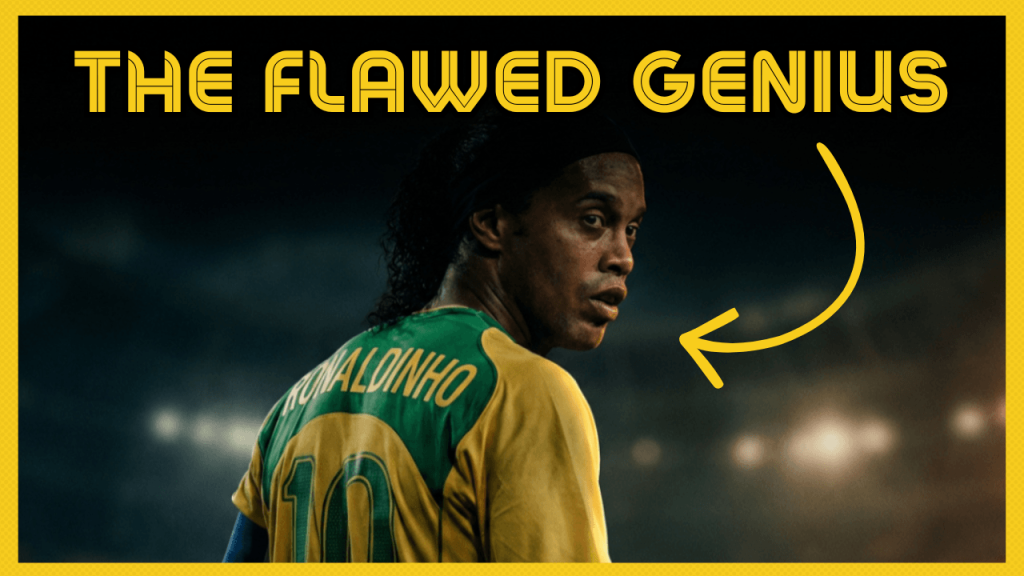
Ronaldinho: O Bruxo, The Wizard Who Made Football Joyful and Then Let It All Go
On 19 November 2005, at the Santiago Bernabéu, Ronaldinho scored twice for Barcelona against Real Madrid. As he walked away from his second goal, the home crowd (80,000 Real Madrid supporters) rose and gave him a standing ovation. A visiting player receiving sustained applause from their most bitter rival’s fans has happened almost never in El Clásico history. The only comparable moment was Diego Maradona at the same ground in 1983.
That moment tells you everything about what Ronaldinho was at his peak. And then there is 2008: Ronaldinho at 28, the age when most elite forwards are at the absolute summit of their ability, arriving at training out of shape, the commitment gone. A player who had spent a decade playing football with uncontained joy finding that the joy had run out.
Born in Porto Alegre in 1980, losing his father at age eight, learning the game on futsal courts where close control was everything, he carried that technical mastery to Grêmio, Paris Saint-Germain, and then in 2003 to Barcelona. At the Camp Nou, he was simply the best player in the world for two extraordinary seasons. He won two Ballon d’Ors, a Champions League, two La Liga titles, and made football look like something different from the game everyone else was playing.
He is the only player in history to have won a World Cup, a Copa América, a Confederations Cup, a Champions League, a Copa Libertadores, and a Ballon d’Or.
Key Facts
Quick context before you watch:
- Full Name: Ronaldo de Assis Moreira; born 21 March 1980, Porto Alegre, Brazil
- Clubs: Grêmio, Paris Saint-Germain, Barcelona, AC Milan, Flamengo, Atlético Mineiro, Fluminense, Querétaro, Atlético Corozal
- Ballon d’Or: 2004 and 2005
- Champions League: won with Barcelona 2005-06
- La Liga Titles: 2004-05, 2005-06
- World Cup: winner with Brazil 2002
- Copa Libertadores: won with Atlético Mineiro 2013, aged 33
- The Bernabéu Ovation: 19 November 2005, Real Madrid fans applauded him after he scored twice in a 3-0 El Clásico win
- Paraguay: arrested March 2020 for entering the country on falsified documents; detained 32 days; paid $90,000 fine; no criminal record
- Honours: The only player in history to have won a World Cup, Copa América, Confederations Cup, Champions League, Copa Libertadores and a Ballon d’Or
Watch the Ronaldinho Documentary
Ronaldinho Gaucho: Early Life and Football Career
Barcelona, the Bernabéu and the Decline
Barcelona paid €30 million for Ronaldinho in 2003. It proved to be the most consequential €30 million in the club’s recent history. Frank Rijkaard’s side had won nothing in four years; within two seasons, with Ronaldinho at the centre of everything, they won back-to-back La Liga titles and the Champions League. The Bernabéu ovation in November 2005 was the moment of maximum recognition, football’s version of a standing ovation at Carnegie Hall.
The decline, when it arrived, was swift. The 2006 World Cup in Germany was already a ghost of the promise. Brazil went out to France 1-0 in the quarter-final with Ronaldinho almost entirely absent. He returned to Barcelona out of shape. By 2007, Pep Guardiola, appointed for the following season, had already decided Ronaldinho would not be part of the future. Barcelona sold him to AC Milan in 2008 for €21 million.
What followed was an extended epilogue with flashes of the old brilliance. At Atlético Mineiro in 2013, aged 33, he won the Copa Libertadores, completing the unique six-trophy set that no other player in history has achieved. He retired in 2018. In March 2020, he was arrested in Paraguay for entering the country on false documents, spending 32 days in detention before paying a $90,000 fine. Even the end was extraordinary.
READ MORE: The Life and Career of Ronaldinho: Deep Dive →
Frequently Asked Questions (FAQs)
Who is Ronaldinho and why is he considered one of the greatest footballers ever?
Ronaldinho, full name Ronaldo de Assis Moreira, is a Brazilian former professional footballer born on 21 March 1980 in Porto Alegre. He won the Ballon d’Or twice (2004 and 2005), was named FIFA World Player of the Year twice, won the Champions League with Barcelona (2006) and the World Cup with Brazil (2002). He is widely regarded as one of the most naturally gifted and entertaining players in football history, and is the only player to have won a World Cup, Copa América, Confederations Cup, Champions League, Copa Libertadores, and a Ballon d’Or.
Why is he called Ronaldinho?
The name “Ronaldinho”, meaning “Little Ronaldo” in Portuguese, was used to distinguish him from the other great Brazilian Ronaldo of his era: Ronaldo Luís Nazário de Lima, the striker known simply as Ronaldo. Both were active at the same time. Diminutive suffixes are a common way to differentiate players sharing names in Brazilian football. The nickname stuck and became the only name by which he is known globally.
What was the Bernabéu standing ovation and why did it happen?
On 19 November 2005, Ronaldinho played for Barcelona against Real Madrid at the Santiago Bernabéu. He scored two goals and delivered a masterclass that made one of world football’s most partisan crowds forget their allegiances. As he left the pitch, or walked away from goals, Real Madrid supporters rose and applauded him. It was spontaneous and sustained. The only Barcelona player previously to receive that honour at the Bernabéu was Diego Maradona in 1983. The event is widely cited as the clearest example of a player transcending rivalry through sheer quality.
How many Ballon d’Or awards did Ronaldinho win?
Ronaldinho won the Ballon d’Or twice: in 2004 (for performances during the 2003-04 season at Barcelona) and 2005 (for the 2004-05 season). He also won the FIFA World Player of the Year award in 2004 and 2005. He was UEFA Club Footballer of the Year for 2005-06. During his two-season peak at Barcelona he accumulated every individual honour the game could offer a club footballer.
Did Ronaldinho win the Champions League?
Yes. Ronaldinho won the Champions League with Barcelona in 2005-06, when they defeated Arsenal 2-1 in the final at the Stade de France in Paris on 17 May 2006. Arsenal took the lead through a Sol Campbell header despite having a man sent off early, but late goals from substitute Henrik Larsson, who came on and set up both equalisers, sealed the trophy for Barcelona. It remains Ronaldinho’s only Champions League title.
What happened when Ronaldinho declined at Barcelona?
The decline began around 2006-07 and became undeniable in 2007-08. Reports from inside Barcelona described Ronaldinho arriving at training inconsistently, his physical condition deteriorated, and his commitment questioned. His coach Luis Fernandez at PSG had noted similar tendencies years earlier. By the time Pep Guardiola was appointed in 2008, the decision was made quickly: Ronaldinho was sold to AC Milan for €21 million. He was 28. Most elite forwards are at their peak at that age. The coincidence of his decline with Lionel Messi’s emergence at Barcelona, replacing one genius with another, made the contrast especially stark.
Did Ronaldinho win the Copa Libertadores?
Yes, and in remarkable circumstances. After his years at Barcelona and AC Milan, Ronaldinho returned to Brazil and in 2013 won the Copa Libertadores with Atlético Mineiro, the first time the club from Belo Horizonte had ever won South America’s premier club competition. He was 33 years old. He contributed four goals and seven assists across the campaign. The victory completed the unique set of six major trophies that no other player in football history has won.
What was the Ronaldinho crossbar YouTube video?
In October 2005, Nike released a video of Ronaldinho receiving a pair of gold boots and then, on an empty pitch, striking the crossbar three consecutive times, controlling the ball each time without it touching the ground. It became the first video in YouTube history to reach one million views. Whether it was genuine has been debated ever since; Nike eventually confirmed the footage was edited. The debate itself was entirely characteristic: Ronaldinho was the only player where the question “could he actually do that?” was something a reasonable person would ask in all seriousness.
What happened to Ronaldinho in Paraguay in 2020?
In March 2020, Ronaldinho and his brother Roberto arrived in Paraguay for a promotional event. At the airport they presented Paraguayan passports. The documents were authentic in form but contained false personal information. Paraguayan authorities arrested the brothers on 6 March, two days after their arrival, following a hotel raid. They were held for 32 days in a maximum-security prison in Asunción. After paying $800,000 in bail each they were moved to house arrest at a hotel, remaining in Paraguay for five months in total. Prosecutors ultimately concluded Ronaldinho had been deceived by a Brazilian businessman who provided the false documents. He paid a $90,000 fine and left with no criminal record.
Did Ronaldinho play with Jay-Jay Okocha at PSG?
Yes. Ronaldinho joined PSG from Grêmio in 2001, aged 20. Okocha was already the established star of the team. He took Ronaldinho under his wing, helped him adapt to European football and life in Paris, and provided a model of how to express individual creativity at a major club without compromising it for tactical convention. Ronaldinho has described Okocha as a “senior brother.” The two played together for one season before Ronaldinho was sold to Barcelona for €30 million.
Did Ronaldinho receive a standing ovation from Real Madrid fans?
Yes. On 19 November 2005 at the Bernabéu, after Ronaldinho’s second goal in a 3-0 Barcelona victory, the Real Madrid crowd gave him a sustained standing ovation. He described it afterwards as a moment few players ever experience: the fans of your biggest rival acknowledging that what they are watching transcends the result. It has been cited in numerous polls as one of the defining moments in El Clásico history.
What is Ronaldinho’s legacy in football?
Ronaldinho’s legacy is the legacy of joy: the proof that football at its highest level could still contain moments of unrepeatable individual expression. He played without compromise, chose the audacious option, and communicated through his body language on a football pitch a relationship with the game that went beyond performance. The smile was real. The joy was real. He inspired Neymar, Kevin de Bruyne, and a generation of players who grew up watching him. Lionel Messi has described watching Ronaldinho train at Barcelona as a formative experience in his own development.
What clubs did Ronaldinho play for and when?
In chronological order: Grêmio (Brazil, 1998-2001), Paris Saint-Germain (France, 2001-03), FC Barcelona (Spain, 2003-08), AC Milan (Italy, 2008-11), Flamengo (Brazil, 2011-12), Atlético Mineiro (Brazil, 2012-14), Querétaro (Mexico, 2014-15), Fluminense (Brazil, 2015-18), Atlético Corozal (Colombia, brief spell before retirement). He retired in January 2018 at the age of 37.
How did Ronaldinho win a World Cup with Brazil?
Brazil won the 2002 World Cup in Japan and South Korea with Ronaldinho as one of the Three Rs, alongside Ronaldo and Rivaldo. In the quarter-final against England, Ronaldinho delivered a free-kick from wide on the right in the 50th minute that arced over goalkeeper David Seaman and into the net. Whether he intended to shoot or cross has never been definitively resolved; he has given both answers at different times. Brazil beat Germany 2-0 in the final, with Ronaldo scoring both goals. Ronaldinho was 22 years old.
What does the Ronaldinho documentary on The Football Documentary Channel cover?
The TFDC documentary follows Ronaldinho’s career from the futsal courts of Porto Alegre, through PSG and the mentorship from Okocha, to Barcelona’s golden era, the Bernabéu ovation, the startling decline, and the Copa Libertadores redemption at 33. It explores the paradox at the heart of his career: a player who played with so much joy that the joy eventually consumed the discipline needed to sustain it. It is free to watch at youtube.com/@footballdocumentaries. The full companion deep dive is at footballdocumentaries.com/ronaldinho/.
The Complete Career of Ronaldinho
For the complete career of Ronaldo de Assis Moreira (the early years, key matches, scandals, and all important FAQs) read the companion deep dive:
READ MORE: The Life and Career of Ronaldinho: Deep Dive →
Watch the Ronaldinho Documentary
Ronaldinho Gaucho: Early Life and Football Career