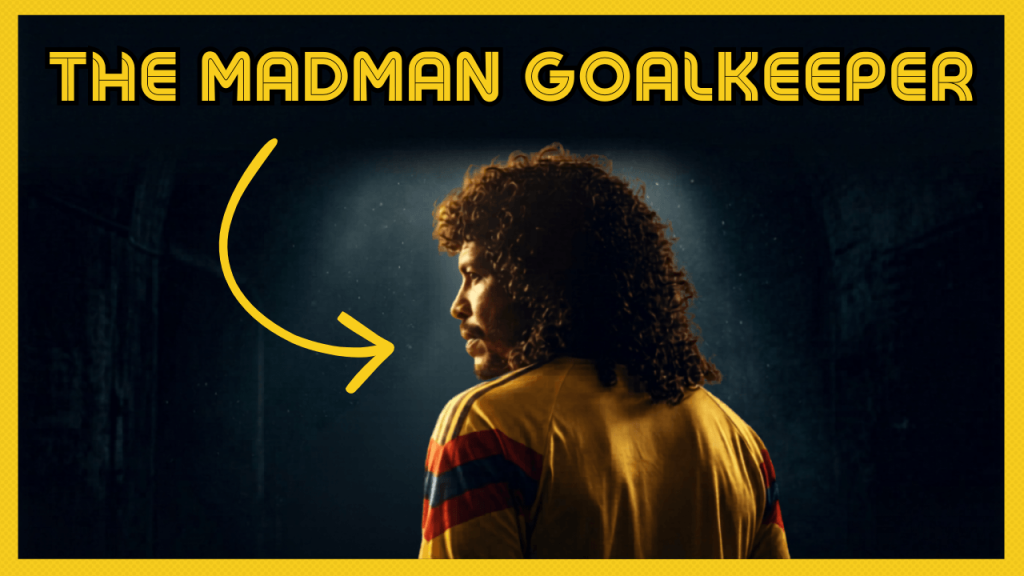
René Higuita: El Loco, Sweeper-Keeper, Scorpion King, and the Goalkeeper Who Changed Football Forever
He grew up in the slums of Medellín in a Colombia that was tearing itself apart. He became a goalkeeper by accident: a teammate was injured during a five-a-side match and someone had to stand between the posts. He won the Copa Libertadores with a team backed by a drug lord, was jailed for acting as a ransom courier in a cartel kidnapping, performed what many consider the most audacious act in football history in front of 20,000 people at Wembley, and retired at 43 having scored 41 goals as a goalkeeper. He helped trigger a rule change that transformed the modern game. In Colombia, that rule still bears his name.
This is the full story of René Higuita, the Football Maverick who refused to be contained by a position, a country, or the laws of physics. The man the world called El Loco, who insisted, with characteristic lack of embarrassment, that he was the sanest player of them all.
Watch the René Higuita Documentary
René Higuita: The Life and Career of El Loco, The Madman
Key Facts
Quick context before you watch:
- Full Name: José René Higuita Zapata. Born 27 August 1966, Castilla, Medellín, Colombia.
- Nickname: El Loco (“The Madman”), given by coach Francisco Maturana.
- Started career as a striker. Became a goalkeeper by filling in during an injury in a five-a-side game as a teenager.
- Club Career: Millonarios → Atlético Nacional (majority of career) → Real Valladolid (Spain) → Atlético Nacional → Veracruz (Mexico) → multiple Colombian clubs → SD Aucas (Ecuador) → Guaros FC (Venezuela). Final appearance: 25 January 2010, Medellín. Retired age 43.
- International: 68 caps, 3 goals for Colombia (1987 to 1999). 1990 World Cup (played) | 1994 World Cup (absent: released from prison unfit; not selected for the squad).
- Club Honours: Copa Libertadores 1989 (Atlético Nacional) | Copa Interamericana 1989, matches played July to August 1990 (Atlético Nacional, beat UNAM 6-1 agg.) | Colombian Primera A: 1991, 1994 (Atlético Nacional).
- Scorpion Kick: 6 September 1995, Wembley, England vs Colombia friendly. Clearing a Jamie Redknapp cross (Redknapp’s England debut). Crowd: approximately 20,000.
- Jailed: June 1993 to January 1994 (7 months without charge) for acting as a paid go-between in a kidnapping case involving drug trafficker Carlos Molina. Received $64,000, illegal under Colombian law.
- Career Goals: 41 (some sources cite 43 including exhibition matches).
- The 1992 back-pass rule is known in Colombia as the “Higuita Rule.”
- IFFHS: 8th greatest South American goalkeeper in history.
- Netflix Documentary: Higuita: The Way of the Scorpion (2023).
Watch the René Higuita Documentary
René Higuita: The Life and Career of El Loco, The Madman
Castilla, Medellín, and the Boy Who Played as a Striker
José René Higuita Zapata was born on 27 August 1966 in Castilla, a lower-middle-class neighbourhood in Medellín, Colombia’s second city and, by the late 1970s, the cocaine capital of the world. His father, Jorge Zapata, left the family when René was young, so young that he grew up taking his mother’s surname rather than his father’s, which is why the world knows him as Higuita and not Zapata. His mother, María Dioselina, raised him on modest means in Castilla’s dense urban streets. When she died while he was still a child, his grandmother Ana Felisa took over. It was, by any measure, a difficult start, in a city that was rapidly becoming one of the most violent on earth.
Medellín in the 1970s and 1980s was a place of extraordinary, combustible contradictions. A city of exceptional beauty, set in a valley ringed by mountains, a place of flowers and eternal spring, it had also become the operational headquarters of Pablo Escobar’s Medellín Cartel, and the murder rate was climbing towards figures that no other city in the world could match. Poverty and glamour existed in adjacent streets. Footballers were the barrio’s great exports; they were trusted by everyone, courted by the powerful, and insulated, to a degree, from the worst of what was happening outside their pitch. Football was the one language that crossed the city’s many dangerous boundaries without needing a passport. Higuita grew up playing it everywhere: on the streets, on the pitches that Escobar had built as community gestures throughout Medellín’s poorest neighbourhoods. He started, as most of his generation did, as a forward.
He was a striker, and by his own account a good one, the top scorer in his school team. The shift to goalkeeper came, as with so many things in his life, by accident. During a five-a-side game as a teenager, the team’s goalkeeper was injured. Higuita volunteered. He performed well enough that the arrangement became permanent. His instincts as a forward (reading where a cross was going to land, carrying the ball under pressure, the nerve and the technique) were not liabilities in goal. They were assets. He had been trained by the game itself, on the streets of Castilla, where the ball was never supposed to be given away cheaply.
He made his professional debut for Millonarios in 1985, age eighteen, one of Colombian football’s most storied top-flight clubs, based in Bogotá. One season was enough to establish his ability. In 1986, Atlético Nacional of Medellín came calling. He went home.
Atlético Nacional: Maturana and the Birth of El Loco
Atlético Nacional were, by the mid-1980s, the dominant club in Colombian football, and not entirely for sporting reasons. Pablo Escobar had invested heavily in the club through intermediaries, using Nacional’s success as a combination of public relations exercise, money-laundering infrastructure, and genuine passion project. The drug lord loved football. He built pitches throughout Medellín’s poorest neighbourhoods, the same pitches Higuita had grown up playing on. That he also ran a criminal empire responsible for thousands of deaths was, in the framework of Colombian football of that era, simply part of the landscape. The lines between cartel money and football money had long since blurred beyond recognition.
Into this environment, Francisco Maturana arrived as coach. Maturana was a dentist by original profession and a football philosopher by vocation, one of the most influential coaches South America produced in the twentieth century, and the man most responsible for the extraordinary Colombian side that captivated the world between 1989 and 1993. His philosophy was built on possession, movement, and freedom of expression. He wanted his players to play without fear. He specifically wanted his goalkeeper to play without fear.
When Maturana saw what Higuita could do with the ball at his feet, the composure, the passing range, the absolute refusal to simply punt the ball downfield, he understood that he had something unprecedented. He gave Higuita a specific role: the goalkeeper-libero, the sweeper in goal. He encouraged him to come out of his area, to join the build-up, to act as an eleventh outfield player when possession was secure. His famous summary: ‘With René as sweeper, we have 11 outfield players.’ He also gave him a nickname: El Loco. The Madman. It was affectionate. Higuita embraced it completely.
What Maturana had done was genuinely revolutionary, though it would take the rest of football some time to catch up. Every modern goalkeeper who plays with their feet, who sweeps behind their defensive line, who functions as an outfield player in build-up (Manuel Neuer, Ederson, Alisson, Marc-André ter Stegen) plays in the tradition that Maturana and Higuita created in Medellín in the late 1980s. The position of the sweeper-keeper was mapped out here, in this unlikely partnership between a dentist-turned-coach and a boy who had started his career as a striker.
Watch the René Higuita Documentary
René Higuita: The Life and Career of El Loco, The Madman
The Copa Libertadores: Down Two Goals and Into History
Atlético Nacional’s 1989 Copa Libertadores campaign began improbably and ended impossibly. The final was against Club Olimpia of Paraguay, an experienced, established side who had reached two previous finals and won one. The first leg, played in Olimpia’s home city of Asunción, went badly for Nacional: they lost 0-2. Returning to Colombia needing to overturn a two-goal deficit, they were required to draw on everything Maturana had built, and they did. They won the second leg convincingly enough to take the tie to a penalty shoot-out.
What followed was vintage Higuita. He saved four of Olimpia’s five penalties. He then stepped forward and scored one himself. Nacional won the Copa Libertadores, the first Colombian club ever to do so. It was, for the country, a seismic moment: Colombia on the continental map, with a goalkeeper at the centre of it all who could not have been more unlike any goalkeeper the sport had seen.
There was, inevitably, controversy. Escobar’s influence over the club and the Libertadores campaign was widely suspected: allegations that officials had been pressured or threatened circulated through South American football circles, and CONMEBOL subsequently banned all Colombian clubs from the 1990 competition except Nacional, who competed as defending champions but were required to play their home games in Chile. Whether any of that diminishes Higuita’s penalty heroics is a question for the individual conscience.
That year, Nacional also claimed the Copa Interamericana, the competition between the Copa Libertadores champion and the CONCACAF Champions’ Cup winner. Due to the competition’s typical 12-to-18-month scheduling lag, the matches were actually played in July and August 1990, despite the edition being listed as the 1989 tournament. Their opponents were UNAM (Pumas) of Mexico. Nacional won the first leg 2-0 at the Atanasio Girardot Stadium in Medellín, then dismantled Pumas 4-1 in Mexico City, a 6-1 aggregate that was as comfortable as it sounds. Higuita had a Copa Libertadores, a Copa Interamericana, and by the time Nacional won the Colombian Primera A in 1991, a league title. He was still only twenty-four.
The logic of the sweeper-keeper was not immediately obvious to everyone watching in 1989. Goalkeepers were supposed to stay close to their line, to concentrate on shot-stopping. What Higuita did (receiving passes in midfield, dribbling past opposing forwards, taking set pieces, roaming thirty yards from goal to manage play) was seen by the football establishment as either brilliance or madness, depending on who you asked. Maturana’s position was that there was no meaningful distinction. ‘Football greats like Pelé and Maradona were very good players,’ Higuita would say years later, ‘but they didn’t change a rule at FIFA.’ He was referring to something that was still three years away. He already knew it was coming.
Italia 90: Roger Milla and the Mistake as Big as a House
Colombia’s 1990 World Cup was the culmination of everything Maturana had built. Their first World Cup since 1962, reached via a campaign built on the short-passing, goalkeeper-libero style that had won them the Copa Libertadores, and they looked the part. They squeaked through the group stage needing a 93rd-minute equaliser against West Germany to advance, but they were there. In the round of sixteen, they faced Cameroon, the breakout stars of the tournament, who had already beaten Argentina in the group stage.
Cameroon had a secret weapon, and it was one specifically designed to exploit Higuita. Roger Milla, thirty-eight years old, playing out of retirement because the Cameroonian president had personally asked him to, had played alongside Carlos Valderrama at Montpellier and had spent time specifically studying Higuita’s habit of leaving his line. ‘Through Valderrama, I’d seen videos of Higuita dribbling the ball out of his area,’ Milla said years later. ‘I knew if I was quick enough I might be able to take advantage of a mistake.’
The match went to extra time at 0-0. Milla came on as a substitute and, in the 106th minute, scored to put Cameroon ahead. Two minutes later came the moment that has defined Higuita’s relationship with the word “mistake” ever since. With the ball played back to him in the Colombia half, Higuita (as was his custom, his philosophical position, his reason for being) moved forward to control it and construct. Milla closed quickly and intelligently, dispossessing the goalkeeper with the goal empty behind him, and rolled it home. Cameroon 2-0. Colombia scored one before the whistle, but it was over.
Higuita never hid from it. ‘It was a mistake as big as a house,’ he said immediately after the match, and has repeated without qualification ever since. He did not disown the style that produced the mistake. He could not. The style was inseparable from who he was. Playing as a goalkeeper who stayed in his box and punted the ball long was, to Higuita, simply not football. That Milla took advantage of it on one occasion was the price of playing the way he played on every other.
Colombia went home. But the football the world had watched in Italy had planted something in the minds of FIFA’s administrators. The tournament averaged a record-low 2.2 goals per game, produced by teams playing backwards, playing time, playing safe. Goalkeepers received back-passes and held the ball for minutes at a time without consequence. FIFA decided that something had to change.
The Pass-Back Rule: How Higuita Changed Football’s Laws
In June 1992, at the Barcelona Olympics, the competition FIFA used to trial major rule changes before rolling them out to the senior game, the back-pass rule came into effect. From that point onwards, a goalkeeper who handled a deliberate back-pass from a teammate would concede an indirect free kick. The rule would be extended across all FIFA competitions the following year, and the impact was immediate: the 1994 World Cup averaged 2.7 goals per game, the highest since 1970.
In Colombia, this rule is known as the Higuita Rule.
Higuita himself has never been modest about the connection. ‘Football greats like Pelé and Maradona were very good players, but they didn’t change a rule at FIFA,’ he said. ‘I did.’ Historians of the game are more careful: the rule change was a response to the overall stagnation of Italia ’90, not solely to Higuita, but the argument is not simply self-promotional swagger. He is the only goalkeeper of his era who demonstrated, at a World Cup, what football could look like if a keeper played with their feet. Every other goalkeeper of that tournament held the ball, killed time, and invited the administrators’ frustration. Higuita alone showed the alternative. FIFA chose to legislate for it.
The irony that his own mistake against Cameroon was part of what prompted the change is not lost on him. His play was so different, so confronting to conservative assumptions, that the administrators had to respond. They could either ban what he was doing or make it universal. They effectively made it universal. Every goalkeeper who plays with their feet today (every sweeper-keeper who is fundamental to how the game is played at the highest level) is doing so within a framework that Higuita’s career helped create. He is the only footballer who can plausibly claim to have changed a FIFA rule. As he says, Pelé and Maradona cannot say the same.
Watch the René Higuita Documentary
René Higuita: The Life and Career of El Loco, The Madman
The International Career: Copa Américas and the Golden Generation
His first major tournament was playing at the 1987 Copa América, where Colombia were knocked out in the first round without making an impression. But the experience, and the growing authority of Maturana’s tactical system, meant that by 1989 Nacional (and by extension, the national team) were a different proposition entirely.
In 1990, Colombia qualified for the World Cup for the first time in 28 years. The campaign was built on the short-passing, possession-first game that Maturana had established, with Higuita functioning as an eleventh outfield player, the system’s most visible tactical innovation. Their group stage performances, including an improbable late equaliser against West Germany, gave the world a first look at this Colombian side, and what it saw was remarkable. Even the Milla disaster could not undo what had been established: Colombia were, demonstrably, one of the most technically gifted international sides on earth.
The 1991 Copa América, held in Chile, confirmed it. Colombia finished fourth, with Higuita in goal throughout. But the performance that truly announced the golden generation was still to come: in September 1993, in qualifying for the 1994 World Cup, Colombia travelled to Buenos Aires and beat Argentina 5-0. In Buenos Aires. At the Estadio Monumental. Against a side containing Claudio Caniggia and Diego Simeone, with the Argentine crowd (one of the most demanding in football) applauding the Colombians at the end. Pelé named Colombia as his favourites to win the 1994 World Cup. The qualifying campaign ended with Colombia unbeaten in their first five matches, conceding only two goals.
At the 1993 Copa América in Ecuador, Colombia finished third, their best result in the competition since the 1940s. Higuita, however, was already in the eye of the storm that would deny him USA 94.
After his prison sentence and absence from the 1994 tournament, he was recalled to the national squad and played in the 1995 Copa América in Uruguay, where the Scorpion Kick had already made him, briefly, the most famous goalkeeper on earth. His final international appearances came at the 1999 Copa América in Paraguay. He finished his international career with 68 caps and three goals, a tally that, for any outfield player, would be respectable. For a goalkeeper, it is extraordinary.
The Escobar Connection: La Catedral, Carlos Molina and Seven Months in Prison
To understand the kidnapping case that destroyed Higuita’s 1994 World Cup, you need to understand the world he lived in. Medellín in the early 1990s was the most violent city on earth. Pablo Escobar’s Medellín Cartel was at war (with rival cartels, with the Colombian government, with the United States) and football was one of the few social institutions that continued to function across the boundaries that violence had created. Players like Higuita occupied a unique position: famous enough to move between worlds that ordinary people could not, trusted by communities that trusted no one else.
Pablo Escobar was a childhood acquaintance: in Medellín, you did not have to be close to a powerful man to be in his orbit; you simply had to live in his city and move in spaces he controlled. In 1991, Escobar turned himself in to Colombian authorities and was housed in La Catedral, a prison of his own design on a mountainside outside Medellín, complete with a football pitch, a bar, and a jacuzzi. Footballers were summoned there regularly. Declining such invitations was not straightforward. When Higuita was photographed outside La Catedral by reporters and asked whether he was Escobar’s friend, he answered that he was. It was the kind of honesty that played well in Castilla and catastrophically everywhere else.
In June 1993, a separate strand of the cartel’s operations involved him in a way he had not anticipated. Carlos Molina (a drug trafficker connected to Nacional, a man Higuita knew through football) had his daughter kidnapped. The kidnapping was orchestrated by Escobar’s network, demanding a ransom of $3 million. Molina could not go to the police: his own activities made that impossible. He turned to Higuita. The footballer was trusted, publicly visible, and capable of moving through Medellín’s underworld without triggering a catastrophe.
Higuita agreed to help. He acted as the go-between: carrying Molina’s ransom payment to the kidnappers, facilitating the release of the girl. The girl was freed. Higuita received $64,000 for his role. Colombian law is explicit: it is a criminal offence to profit from a kidnapping, regardless of motive. In June 1993, he was arrested.
He was jailed for seven months without charge. During that time, he went on a two-week hunger strike to protest against the absence of any formal legal proceedings. He was released in January 1994 without ever being formally charged. But seven months without training, without the structures of professional football, had left him physically unfit. The 1994 World Cup (for which Colombia had qualified as one of the tournament favourites, having demolished Argentina 5-0 in qualifying) began in the United States that summer without him.
In the ESPN documentary The Two Escobars, Higuita offered a different account: he claimed his arrest was primarily about his association with Escobar himself, and that the authorities had used the ransom case to lever him for information. His public statement at the time was simpler: ‘I’m a footballer. I didn’t know anything about kidnapping laws.’ He was also, when asked in a later interview whether he would visit Escobar in prison again, unequivocal: ‘Today, tomorrow and always.’
1994: The World Cup Without Him, and the Death of Andrés Escobar
Colombia arrived at USA 94 as one of the tournament favourites. Pelé had named them as his pick to win it. They had qualified by going unbeaten in their first five matches, conceding only two goals, and then destroying Argentina 5-0 in Buenos Aires, one of the most spectacular qualifying performances in World Cup history. The Argentine fans gave them a standing ovation. They were considered one of the most technically gifted international sides in the world.
What followed was shaped by forces that had nothing to do with football. Before the tournament began, death threats were sent to players and their families. The son of one squad member had been kidnapped during the qualifying campaign. More than half the squad played for clubs with narco-trafficker financial backing, six from Atlético Nacional, five from América de Cali, which meant there were people with very specific and very dangerous interests in the results. The pressure bearing down on these men was not the pressure of sport.
Colombia lost their first group game 3-1 to Romania, then faced the host nation, the United States, in what was already effectively a must-win. On 22 June, in the 35th minute, defender Andrés Escobar (a quiet, principled man known throughout Colombian football by his nickname El Caballero del Fútbol, the Gentleman of Football) stretched to intercept a left-wing cross from US midfielder John Harkes and inadvertently deflected the ball past his own goalkeeper. The US won 2-1. Colombia beat Switzerland in their final group game but it was not enough. They went home bottom of the group.
Ten days after the own goal, on 2 July 1994, Andrés Escobar was murdered. He was shot six times outside a nightclub in the El Poblado district of Medellín at approximately 3 a.m. Reports stated that his killers shouted ‘Gol!’ after each shot, once for each time a commentator had said it during the broadcast of the fateful own goal against the United States. The man convicted of firing the shots was a bodyguard and driver for the Gallón brothers, gambling moguls believed to have lost heavily betting on the Colombia match. He served eleven years of a forty-three-year sentence. The Gallón brothers were imprisoned briefly for obstructing justice. In February 2026, one of them was shot dead in Mexico.
Andrés Escobar was twenty-seven years old. His funeral was attended by more than 120,000 people.
Higuita was not at the World Cup. He had been released from prison in January, physically unfit, excluded from the squad entirely. He watched Colombia’s collapse and his teammate’s murder from home. Andrés Escobar had been his clubmate at Nacional for years. Whether Higuita’s presence in goal (his composure, his leadership, the stabilising effect his play had on those around him) would have made any difference on the pitch is unknowable. What happened off the pitch was beyond football entirely.
The Scorpion Kick: Wembley, 6 September 1995
The idea came from a child.
Higuita had been watching a soft drink commercial in Colombia when he saw a boy kick a ball backwards with his heels, a bicycle kick in reverse. He started working on it in training. For approximately two years, he refined the movement in warm-ups and practice sessions, pulling it out before matches to the amusement and occasional alarm of teammates. David Seaman, England’s goalkeeper, was warming up at Wembley on 6 September 1995 when he saw Higuita doing it in the Colombian end. ‘As we warmed up before the match, I saw Rene practising his scorpion kick, and I thought: there’s no way he’ll do it in the match,’ Seaman recalled, thirty years later, interviewed to mark the anniversary in September 2025. ‘I’m sure he was prepared for this, but even after 30 years, it’s still one of the most incredible moments I’ve ever seen.’
The match itself was an unremarkable Wednesday night friendly, England against Colombia, a post-Escobar murder, post-1994 World Cup attempt by both nations to reset. England were rebuilding under Terry Venables after the embarrassment of missing USA 94. Colombia were readmitting Higuita to international football after his prison exile. The crowd was sparse (around 20,000 at a Wembley that could hold ten times that number) and the game was trundling along without distinction. It was not the occasion on which you expected football history to be made.
Then, in the twenty-second minute, Jamie Redknapp (making his England debut) swung a cross from thirty yards that went badly astray. The ball sailed over everyone in the area, drifted back, and dropped behind Higuita at the far post, falling over his head. A conventional goalkeeper would have caught it or palmed it away. Higuita did not catch it.
He lunged forward, both hands planting on the turf in front of him, body near-horizontal to the ground, and brought both heels up simultaneously over his head in a single explosive movement, striking the ball cleanly with his heels and flicking it away. His body formed the unmistakable silhouette of a scorpion, stinger raised. He immediately broke into his iconic grin.
For a moment, nobody was quite certain what had happened. The linesman raised his flag. Martin Tyler, commentating for Sky Sports, assumed the referee’s whistle had gone. Then play continued. The realisation rippled through the stadium and the broadcast booth simultaneously. Bryan Robson, part of the England coaching staff, was laughing on the bench in near-disbelief. Seaman watched in astonishment from the other end. ‘He foiled Jamie Redknapp and he fooled the lot of us on the gantry!’ Tyler recovered to say.
Terry Venables was gracious: ‘I’ve never seen anything like that before. But I don’t think we will be teaching our goalkeepers to do that, even if it does bring the crowds back.’ Higuita was more precise: ‘I have a massive repertoire but I don’t plan them ahead’, a statement of questionable credibility, given the two years of rehearsal. In an interview with Mundo Deportivo in 2012, he offered a better explanation: ‘Children have always been my inspiration. I always saw them in the street or in a park trying out bicycle kicks, and I told them it would be good to do it in reverse.’
The game ended 0-0. The scorpion kick was everything. It ranked 94th in Channel 4’s 100 Greatest Sporting Moments in 2002. On its thirtieth anniversary in September 2025, Higuita posted on social media: ‘It was not just a save: it was a work of art, a cry for freedom, a gesture that changed forever how we understand the goal.’ He was right. It has been replicated on park pitches on every continent. It is the image that comes to mind when anyone says his name. He was twenty-nine years old when he did it. He carried it, with complete and evident satisfaction, for the rest of his life.
Watch the René Higuita Documentary
René Higuita: The Life and Career of El Loco, The Madman
The Long Tail: Drugs, Exile and a Retirement at 43
What followed the Scorpion Kick was, in footballing terms, an afterword, but one that contained enough incident for another career entirely.
Higuita had spent a season in Spain during 1991-92, playing for Real Valladolid in La Liga. He returned to Colombia mid-season, by most accounts unhappy and unsettled, and spent four more productive years at Atlético Nacional, winning the Colombian Primera A in 1994. He left for Mexico in 1997, playing for Veracruz until 1999, then returned to Colombian football for an extended late career (Independiente Medellín, América de Cali, Junior de Barranquilla, and others) scoring goals with the freedom of a man who had nothing left to prove. During the 1999/2000 season alone, playing for Independiente Medellín, he scored 11 goals in 20 appearances. He was in his early thirties. He was taking penalties and free kicks because clubs knew that fans had paid partly to watch him perform them.
In November 2004, while playing for SD Aucas in Ecuador, he tested positive for cocaine. He was suspended, checked into drug rehabilitation, and did not play professionally again until July 2007. He returned to football (briefly, remarkably) at forty-one, signing for Venezuelan club Guaros FC, then lower-league Colombian sides Deportivo Rionegro and Deportivo Pereira. His final professional appearance was on 25 January 2010 in Medellín. He was forty-three years old.
The goalscoring record is worth pausing on. Forty-one career goals from a goalkeeper, primarily penalties and free kicks, taken because club after club recognised that this was part of what Higuita was, and that they had a duty to their supporters to let him be it, places him among the ten highest-scoring goalkeepers in the history of the sport.
After retiring from playing, Higuita moved into coaching. He had already begun working as a goalkeeping coach at Real Valladolid in late 2008, a separate role from his playing spell there seventeen years earlier. In 2011, he joined Al Nassr FC in Saudi Arabia as goalkeeping coach, remaining there until approximately 2016, five years during which Al Nassr developed their goalkeeper infrastructure substantially. In 2017, he returned to Atlético Nacional as goalkeeping coach, describing the return as ‘the dream of my life.’ Nacional: the club of the Copa Libertadores, of Maturana, of the greatest chapter of his playing career. He was home.
In 2023, Netflix released Higuita: The Way of the Scorpion, a documentary that covered his life, his career, and his complicated relationship with the Escobar era. Higuita participated in the film and used it, in part, to offer his own account of the kidnapping and what the Medellín of that era had actually been like to live in. The film was a hit in Colombia.
Legacy: Why Higuita Still Matters
Every time Manuel Neuer sweeps from his area to intercept a through ball. Every time Ederson plays a line-breaking pass into midfield from his six-yard box. Every time Alisson controls a back-pass on the halfway line and begins an attack from his own feet. Every time a goalkeeper is judged not only by their hands but by what they can do with the ball, Higuita is there. He may not be credited for it in the way he is credited for the Scorpion Kick, but the transformation of the goalkeeper’s role from passive last line to active eleventh man traces directly and specifically back to him.
The Scorpion Kick is the image, but it is arguably the least important thing he did. It was a feat of showmanship in a 0-0 friendly that barely twenty thousand people watched in person. What mattered was the Copa Libertadores, the pass-back rule, the argument he made by simply playing as he played that a goalkeeper was not a specialist defensive appendage but a complete footballer. That argument has reshaped the position permanently.
The complications of his life are not footnotes to the football story. They are part of it. Higuita came from a city and a country where cartel connections, prison sentences, and cocaine were not distant abstractions: they were part of the social architecture. The same environment that produced his talent also produced the kidnapping case and the drug test. That he emerged from all of it still willing to play the game the way he believed it should be played (with joy, with risk, with absolute commitment to the idea that the goalkeeper belonged in the game rather than watching it) is itself a form of courage.
He was asked many times what he would like to be remembered for. His answer, given in a FIFA interview during his playing days, was this: ‘The best thing they can say is that Higuita was a man like many others, an ordinary human being who made mistakes, but who also had his good points too.’ He was always going to be remembered for more than that. The Scorpion Kick alone guaranteed it. But the thing that makes him a Football Maverick in the truest sense (the reason his story belongs here alongside Cantona and Okocha) is not the kick. It is the career-long refusal to accept that there was only one way to play his position. He looked at the role of the goalkeeper and decided it was not a constraint. It was a canvas.
Watch the René Higuita Documentary
René Higuita: The Life and Career of El Loco, The Madman
Frequently Asked Questions (FAQs)
Who is René Higuita and why is he famous in football?
René Higuita is a former Colombian goalkeeper, born in 1966 in Medellín, widely considered one of the most unconventional and influential players in football history. He is famous primarily for three things: his sweeper-keeper playing style (actively leaving his goal, joining build-up play, and functioning as an outfield player) which pioneered the modern goalkeeper’s role; the Scorpion Kick, an acrobatic save he performed at Wembley in 1995 that is regularly cited as the most audacious moment in goalkeeping history; and his connection to Pablo Escobar’s Medellín Cartel, which led to a seven-month imprisonment in 1993 and caused him to miss the 1994 World Cup. He won the Copa Libertadores with Atlético Nacional in 1989, earned 68 caps for Colombia, and scored 41 goals as a goalkeeper.
What was René Higuita’s famous Scorpion Kick and when did he do it?
The Scorpion Kick was a save René Higuita performed on 6 September 1995 during an England vs Colombia friendly at Wembley Stadium. With Jamie Redknapp’s miscued cross dropping over his head and behind him, Higuita dived forward, planted both hands on the turf, and brought both heels up simultaneously over his head to flick the ball away, his body forming the shape of a scorpion with its stinger raised. The move was entirely unnecessary (he could simply have caught the ball), technically extraordinary, and instantly iconic. The game ended 0-0. Higuita had been inspired by watching a child kick a ball backwards during a Colombian soft drink commercial and had rehearsed the movement in training for approximately two years before using it at Wembley. The save was voted 94th in Channel 4’s 100 Greatest Sporting Moments in 2002.
Why was René Higuita called El Loco?
El Loco (“The Madman”) was a nickname given to Higuita by his Atlético Nacional and Colombia coach Francisco Maturana, who used it affectionately to describe Higuita’s high-risk, unconventional approach to goalkeeping. Rather than staying on his goal-line, Higuita routinely dribbled into midfield, played passes to outfield teammates, took set pieces, and attempted to score goals, behaviour that was genuinely unprecedented for a goalkeeper of his era. Maturana’s actual view was that this was tactical innovation, not madness; his famous phrase was ‘With René as sweeper, we have 11 outfield players.’ Higuita embraced the nickname entirely, and it has defined his public identity for more than forty years.
What was René Higuita’s connection to Pablo Escobar?
René Higuita grew up in Castilla, Medellín (the same city as Pablo Escobar) and describes Escobar as a childhood acquaintance rather than a close friend. He played for Atlético Nacional, a club that received significant narco-connected investment during Escobar’s ascendancy. In 1991, Higuita was photographed outside La Catedral (the mountaintop prison Escobar had built to house himself) and confirmed publicly that they knew each other. When Carlos Molina, a drug trafficker connected to Nacional, had his daughter kidnapped in 1993 in a case linked to the cartel, Molina asked Higuita to deliver the ransom. Higuita agreed, the girl was freed, and he received $64,000, an illegal payment under Colombian law. He was arrested and jailed for seven months without charge.
Why did René Higuita miss the 1994 World Cup?
René Higuita missed the 1994 World Cup because he had been imprisoned from June 1993 until January 1994 for his role as a paid go-between in a kidnapping case involving drug trafficker Carlos Molina’s daughter. He received $64,000 for facilitating the girl’s release, illegal under Colombian law, which prohibits profiting from a kidnapping regardless of motive. He was held without charge for seven months and mounted a two-week hunger strike in protest. Though released without formal charge, his time in prison had left him physically unfit. He was not selected for the 1994 squad, which was considered one of the tournament favourites but collapsed dramatically in the group stage in circumstances that went far beyond sport.
What happened to Colombia at the 1994 World Cup?
Colombia arrived at USA 94 as one of the tournament favourites, having beaten Argentina 5-0 in Buenos Aires during qualifying. Under enormous pressure, including death threats against players, cartel betting interests in results, and a squad fractured by fear, they lost 3-1 to Romania in their opener, then conceded an own goal from defender Andrés Escobar in a 2-1 defeat against the United States on 22 June. Despite beating Switzerland, they were eliminated. Ten days later, on 2 July 1994, Andrés Escobar was shot dead in Medellín. His killers reportedly shouted ‘Gol!’ after each of the six shots fired. He was twenty-seven years old. More than 120,000 people attended his funeral.
What was René Higuita’s role in the 1989 Copa Libertadores final?
Atlético Nacional’s 1989 Copa Libertadores final against Club Olimpia of Paraguay was one of the most dramatic in the competition’s history. Nacional lost the first leg 0-2 in Asunción, then recovered to take the tie to a penalty shoot-out after the second leg in Bogotá. Higuita saved four of Olimpia’s five penalties and stepped forward to take and score one himself. Nacional won the Copa Libertadores, the first Colombian club ever to do so. The performance in that shoot-out encapsulated everything about Higuita’s character: he was not the goalkeeper passively observing others under pressure. He was an active participant in the most pressured moment imaginable. He was twenty-two years old.
What was René Higuita’s mistake at the 1990 World Cup against Cameroon?
In the round of sixteen at Italia ’90, with Colombia and Cameroon level at 0-0 in extra time, Higuita received the ball deep in the Colombian half, standard practice for him. Veteran Cameroon striker Roger Milla, who had studied Higuita’s habit of leaving his line while playing alongside Carlos Valderrama at Montpellier, pressed quickly and intelligently, dispossessing the goalkeeper with the goal empty. Milla scored. It made the score 2-0, and though Colombia pulled one back, they were eliminated. Higuita has never minimised what happened: ‘It was a mistake as big as a house.’ He has also never suggested it was a reason to change how he played.
How did René Higuita influence the back-pass rule that changed football?
The 1992 back-pass rule (which prohibited goalkeepers from handling a deliberate back-pass from a teammate, punishing violations with an indirect free kick) was introduced by FIFA following the 1990 World Cup, which produced a record-low 2.2 goals per game amid widespread criticism of time-wasting. In Colombia, this rule is known as the “Higuita Rule,” because Higuita’s sweeper-keeper performances at Italia ’90 demonstrated that a goalkeeper could use their feet constructively rather than hoard possession. Higuita himself states FIFA were ‘inspired’ by his game. Historians are more circumspect, noting the rule addressed all goalkeepers’ behaviour, not Higuita’s alone, but the principle stands: he showed what was possible, and FIFA legislated to require it of everyone else. The rule directly contributed to the rise of the modern sweeper-keeper.
How many goals did René Higuita score in his football career?
René Higuita scored 41 career goals as a goalkeeper, primarily from penalties and direct free kicks, roles he was routinely given because of his exceptional dead-ball technique and because clubs recognised his goal-scoring as part of his entertainment value. This figure places him among the ten highest-scoring goalkeepers in football history. The goals were concentrated in the later stages of his career, when clubs in Colombia and beyond gave him set-piece duties specifically to give fans what they had come to see. During the 1999/2000 season alone, playing for Independiente Medellín, he scored 11 goals in 20 appearances.
What clubs did René Higuita play for during his career?
In chronological order: Millonarios (Colombia, 1985-86), Atlético Nacional (Colombia, 1986-91), Real Valladolid (Spain, 1991-92), Atlético Nacional (Colombia, 1992-96), Veracruz (Mexico, 1997-99), Independiente Medellín (Colombia, 1999-2001), América de Cali (Colombia), Junior de Barranquilla (Colombia), SD Aucas (Ecuador, 2004), Guaros FC (Venezuela, 2007-08), Deportivo Rionegro (Colombia, 2008), and Deportivo Pereira (Colombia). He made his final professional appearance on 25 January 2010 in Medellín, aged 43. The majority of his career was spent at Atlético Nacional, for whom he remains the definitive goalkeeper in the club’s history.
Did René Higuita invent the sweeper-keeper position?
Higuita did not invent the sweeper-keeper from nothing: the lineage of the role includes Argentine goalkeeper Amadeo Carrizo at River Plate in the 1940s and 1950s, and Jan Jongbloed of the Netherlands at the 1974 World Cup. However, Higuita took the concept further than any goalkeeper had at a major tournament, performing it with extraordinary technical sophistication and within a tactical system (Francisco Maturana’s Colombia) that was specifically designed around his participation as an outfield player. Modern practitioners of the role (Manuel Neuer, Ederson, Alisson) play within a framework whose modern form Higuita and Maturana established at the 1990 World Cup. That tournament’s consequence, the back-pass rule, made what Higuita was already doing a requirement for every goalkeeper in the world.
Was René Higuita friends with Pablo Escobar?
Higuita’s account has varied over the years. He has described Escobar as a childhood acquaintance from Medellín rather than a close personal friend, noting that his closer relationship was with Escobar’s brother Roberto. He was photographed outside La Catedral (Escobar’s personal mountaintop prison) and confirmed publicly that they knew each other. In the ESPN documentary The Two Escobars, he suggested his 1993 arrest was more about the authorities leveraging him for information on Escobar than about the kidnapping itself. When asked in a later interview whether he would visit Escobar in prison again, his answer was: ‘Today, tomorrow and always.’ The precise nature of their relationship is contested. That Higuita lived in a world where Escobar’s orbit was inescapable (as a footballer from Medellín in the late 1980s) is not.
How did René Higuita become a goalkeeper if he started as a striker?
Higuita was a prolific striker in his youth, by his own account the top scorer in his school team. During a five-a-side game as a teenager, the team’s regular goalkeeper was injured. Higuita stepped in and performed well enough that the arrangement became permanent. His background as a forward never left him: it informed his comfort on the ball, his instinct to carry possession under pressure, his ability to read crosses as attacking opportunities rather than threats, and his fundamental desire to be a participant in the game rather than a passive last line. The goalkeeper he became was, in essence, the striker he had been, positioned further back and pointing in the other direction.
What was the Netflix documentary about René Higuita?
Higuita: The Way of the Scorpion (Spanish title: Higuita: El camino del Escorpión) is a Netflix documentary about René Higuita’s life and career, released in November 2023. The film covers his upbringing in Medellín, his career at Atlético Nacional and with Colombia, the Escobar connection and imprisonment, the circumstances surrounding the 1994 World Cup, and the Scorpion Kick. Higuita participated in the documentary and used it partly to offer his own account of the kidnapping case and his relationship with the cartel era. The film explores the broader context of Colombian football in the narco period: the investment, the pressure, the murders, and the extraordinary talent that existed within and despite it all.
Who was Andrés Escobar and what happened to him after the 1994 World Cup?
Andrés Escobar (known as El Caballero del Fútbol, the Gentleman of Football) was a Colombian central defender who played for Atlético Nacional and the Colombia national team. He shared a club with Higuita and was widely regarded as one of the most principled and admired figures in Colombian football. At the 1994 World Cup, in Colombia’s second group game on 22 June against the United States, he stretched to cut out a cross from US midfielder John Harkes and inadvertently deflected it into his own net. Colombia lost 2-1 and were eventually eliminated. Ten days later, on 2 July 1994, Escobar was shot six times outside a Medellín nightclub. His killers reportedly called out ‘Gol!’ after each shot. A bodyguard for the Gallón brothers (gambling figures believed to have lost heavily on the Colombia match) was convicted of the killing and served eleven years. Escobar was twenty-seven. More than 120,000 people attended his funeral.
Did René Higuita fail a drugs test?
Yes. In November 2004, while playing for Ecuadorian club SD Aucas, Higuita tested positive for cocaine. He was suspended from football and entered drug rehabilitation. He did not play professionally again until July 2007, when he signed for Venezuelan club Guaros FC, aged forty. He did not speak extensively about the episode in public. The positive test was a personal low point in a career that had already included seven months in prison, a missed World Cup, and years of wandering through clubs in Colombia, Mexico, Ecuador, and Venezuela after the Scorpion Kick had made him famous but professional opportunities at the highest level had largely passed.
What was René Higuita’s international career record with Colombia?
René Higuita played 68 matches for Colombia between 1987 and 1999, scoring three goals. He was first-choice goalkeeper during the generation widely considered the finest in Colombian history, the team built by Francisco Maturana that qualified for their first World Cup since 1962, reached the last sixteen at Italia ’90, beat Argentina 5-0 in qualifying for USA 94, and finished third at the 1993 Copa América. He appeared at the 1987 Copa América (first-round exit), the 1991 Copa América (fourth place), and the 1993 Copa América (third place), as well as the 1990 World Cup. After his imprisonment he returned for the 1995 Copa América and was recalled one final time for the 1999 Copa América in Paraguay.
What did René Higuita do after he retired from playing football?
After his final retirement from playing in January 2010, Higuita moved into goalkeeping coaching. He had already begun a coaching role at Real Valladolid in Spain in late 2008, a separate engagement from his playing spell there in 1991-92. In 2011, he joined Al Nassr FC in Saudi Arabia as goalkeeping coach, remaining until approximately 2016. In June 2017, he returned to Atlético Nacional as goalkeeping coach, describing the move as ‘the dream of my life.’ He has spoken publicly about wanting to coach the Colombia national team. He was the subject of the 2023 Netflix documentary Higuita: The Way of the Scorpion. He lives in Medellín.
What other Football Mavericks documentaries has The Football Documentary Channel made?
The Football Mavericks series on The Football Documentary Channel explores the careers of football’s most brilliant, unconventional, and boundary-pushing players, those who rewrote what was possible on a pitch and left the game permanently different from how they found it. Alongside René Higuita, the series has covered Jay-Jay Okocha (the Nigerian magician who dribbled past Oliver Kahn and carried Bolton Wanderers to a League Cup final) and Eric Cantona, the French genius who burned bright, kicked a fan, and won everything before walking away at thirty. All documentaries are free to watch on YouTube at youtube.com/@footballdocumentaries. Subscribe to be notified when new films are released.
What is the Netflix documentary about René Higuita?
Higuita: The Way of the Scorpion (Spanish: Higuita: El camino del Escorpión) is a Netflix documentary released in November 2023. It covers Higuita’s upbringing in Medellín, his career at Atlético Nacional, the Escobar connection, his imprisonment, the 1994 World Cup he missed, and the Scorpion Kick. Higuita participated in the film and gave his own account of the kidnapping case and the cartel era. The TFDC documentary covers similar ground in a shorter film format, free to watch at youtube.com/@footballdocumentaries.
Is René Higuita considered one of the greatest goalkeepers in history?
Higuita is ranked 8th among all South American goalkeepers in history by the International Federation of Football History and Statistics (IFFHS). He is more broadly ranked among the ten highest-scoring goalkeepers in football history, with 41 career goals. Beyond statistics, his cultural and tactical legacy (pioneering the sweeper-keeper role, inspiring the back-pass rule, and performing the Scorpion Kick) makes him one of the most significant and original figures the position has ever produced.
What does the René Higuita documentary on The Football Documentary Channel cover?
The TFDC documentary tells El Loco’s story: from the streets of Castilla in Medellín, through the 1989 Copa Libertadores triumph, the Italia 90 drama with Roger Milla, his imprisonment in the shadow of the Escobar years, and the Scorpion Kick at Wembley in 1995. It is free to watch at youtube.com/@footballdocumentaries. The full companion deep dive at footballdocumentaries.com/rene-higuita/ covers his complete career, career statistics, and all important FAQs in detail.