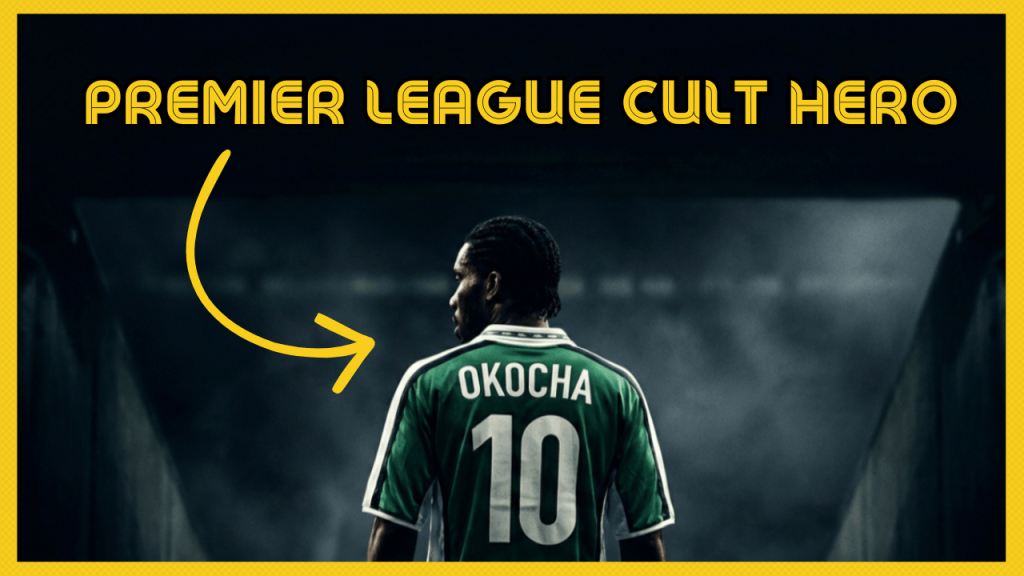
Jay-Jay Okocha: So Good They Named Him Twice, The Full Story of Football’s Most Joyful Maverick
He arrived in Germany on holiday, tagged along to a friend’s training session, and was handed a professional contract the next day. He dribbled past Oliver Kahn, the world’s best goalkeeper, in an 87th-minute counter-attack, took so long doing it that his own manager warned he’d never pick him again if he missed, and produced what Jürgen Klopp later called the greatest goal in Bundesliga history. He became Turkish by name and Nigerian by soul. He mentored Ronaldinho. He carried a Bolton side managed by Sam Allardyce to a cup final at the Millennium Stadium. He helped Nigeria beat Brazil, come back from 2-0 down against Argentina, and win Africa’s first Olympic football gold medal. And he retired in 2008 having never been seriously close to a top-four club, having never won a league title, and having collected exactly zero Ballon d’Or nominations in years when his peers were treated as contenders.
This is the full story of Jay-Jay Okocha, the Football Maverick who played football as though the audience was the point, who was too good for where he ended up and knew it, and who left the game richer for every moment he was in it.
Watch the Jay-Jay Okocha Documentary
Jay-Jay Okocha: So Good, They Named Him Twice
Key Facts
Quick context before you watch:
- Born: 14 August 1973, Enugu, Nigeria. Parents from Ogwashi-Uku, Delta State.
- Full Name: Augustine Azuka Okocha. The name ‘Jay-Jay’ inherited from elder brother James.
- Clubs: Enugu Rangers → Borussia Neunkirchen → 1. FC Saarbrücken → Eintracht Frankfurt → Fenerbahçe → PSG → Bolton Wanderers → Qatar SC → Hull City
- International: 73 caps, 14 goals for Nigeria | Three World Cup squads (1994, 1998, 2002)
- Major Honours: AFCON 1994 | Olympic Gold 1996 (Atlanta) | 2001 UEFA Intertoto Cup (PSG)
- PSG Fee (1998): ~£14m (€12.4m), then the highest ever paid for an African player
- Bolton: voted greatest ever player at the Reebok/Macron Stadium (2017 fan poll)
- BBC African Footballer of the Year: 2003, 2004
- Nigerian Footballer of the Year: 1995, 1997, 2000, 2002, 2003, 2004, 2005
- Nephew: Alex Iwobi (Fulham and Nigeria), Okocha persuaded him to choose Nigeria over England
- FIFA 100 (2004): named by Pelé among the greatest living footballers
Watch the Jay-Jay Okocha Documentary
Jay-Jay Okocha: So Good, They Named Him Twice
The Name, the Family, and the Streets of Enugu
Augustine Azuka Okocha was born on 14 August 1973 in Enugu, in south-eastern Nigeria, to parents who hailed from Ogwashi-Uku in Delta State. He grew up in the kind of environment that produces either footballers or the people who spend their lives watching them: a city where the game was played on any surface that could hold a ball, with anything that could pass for one.
The nickname came from his older brother James, who started playing football first and was called Jay-Jay by teammates and friends. His middle brother Emmanuel was known as Emma Jay-Jay. When Augustine took up the game seriously, the name followed, transferred down through the family like a handed-on jersey number. It stuck, it fitted, and eventually it became the only name that mattered. His full brothers Emmanuel and James both played football at various levels in Nigeria; it was a family in which the game was not merely a pastime.
Okocha’s own description of his earliest football is the one that endures: ‘As far as I can remember, we used to play with anything, with any round thing we could find, and whenever we managed to get hold of a ball, that was a bonus! I mean it was amazing!’ The improvisation was not just circumstantial: it shaped the way he played for the rest of his career. The close control, the ability to do something unexpected in a tight space, the joy in the doing rather than just the result: all of it traces back to those streets.
Enugu Rangers: The Goal That Changed Everything
In 1990, at sixteen, Okocha joined Enugu Rangers, one of Nigeria’s most storied clubs, based in his home city. He would not stay long, but long enough to announce himself in a way that people still talk about. In a match against BCC Lions of Gboko, he rounded experienced Nigerian goalkeeper William Okpara and scored a goal of the kind that makes watching football feel like a privilege. It was the sort of display that, in the pre-internet era, still travelled, by word of mouth, by the raised eyebrows of people who had been in the crowd.
Later that year, Okocha went on holiday to West Germany, the country that had just won the 1990 World Cup, and a nation with the kind of football infrastructure that could actually use what he had. His friend Binebi Numa was playing for Borussia Neunkirchen in the Oberliga Südwest, German football’s third division. One morning, Okocha tagged along to training and asked to join in. The Neunkirchen coach watched him for one session and invited him back the next day. By the end of the week, he had offered him a contract.
This is one of football’s great accidents of geography: the sixteen-year-old from Enugu on a holiday to watch football ends up being handed a contract by the country he came to watch. Had Numa been playing in a different city, or had Okocha taken a different holiday, the whole story changes.
Watch the Jay-Jay Okocha Documentary
Jay-Jay Okocha: So Good, They Named Him Twice
Germany: From Holiday Kickabout to the Bundesliga
Neunkirchen were third division. Okocha was better than third division, and the club knew it almost immediately. After one season he moved to 1. FC Saarbrücken, a step up in quality and profile, before Eintracht Frankfurt brought him to the Bundesliga in December 1991. He was eighteen years old.
Frankfurt were a significant club with significant players: Tony Yeboah, the Ghanaian striker who would later light up the Premier League with Leeds; Thomas Doll, the East German international. For a teenage Nigerian who had been playing street football in Enugu eighteen months earlier, it was an extraordinary leap. He made it look, if not comfortable, then at least navigable. He played with the instinctive confidence of someone who has always been the best player on any given pitch and has not yet been given reason to doubt it.
His first two seasons were a process of acclimatisation. He started games, he came off the bench, he showed enough to keep everyone interested. Then, in his second full season, in the 87th minute of a Bundesliga match on a warm August evening at the Waldstadion in Frankfurt, everything changed.
The Kahn Goal: Eleven Seconds That Made Him Famous
31 August 1993. Eintracht Frankfurt vs Karlsruher SC at the Waldstadion, Frankfurt. 32,000 spectators. Frankfurt were leading 2-1 in the 87th minute, and Klaus Toppmöller had brought Okocha on as a substitute. He received the ball on the counter-attack, near the edge of the penalty area, with Oliver Kahn (already one of the best goalkeepers in the world, soon to be considered the best) standing in his way.
What happened next lasted approximately eleven seconds. Okocha feinted to shoot with his right foot. Kahn did not move. He shifted the ball and feinted to shoot with his left. Kahn held his ground. He dribbled past Kahn with a body feint that sent the goalkeeper sprawling to the turf, then found his path to goal blocked by Karlsruhe defenders who had scrambled back, among them, Slaven Bilić, the future international manager, racing forward off the line to help. Okocha went left. He went right. He dummied again. He dribbled past one defender, then another, then, with Kahn having recovered his position and Bilić closing, pulled back his left foot and fired the ball between two bodies and into the net. Final score: 3-1.
It was not a nutmeg: the ball did not go through Kahn’s legs. It was something more humiliating in its way: a player standing in front of the world’s best goalkeeper for eleven seconds, refusing to shoot, dribbling past him when he finally committed, then doing it to three more defenders for good measure. Kahn said afterwards, and has said on multiple occasions since: ‘I’m still dizzy, even now.’ Jürgen Klopp, interviewed decades later, called it the greatest goal ever scored in the Bundesliga. The Sportschau television programme, Germany’s Match of the Day equivalent, voted it their Goal of the Year for 1993. Football magazines across Germany ran it on their covers.
In a single match, in a single moment, Okocha had gone from a promising young African player in the Bundesliga to someone whose name people knew. Okocha himself gave the most honest account of what happened: ‘That goal changed my life and made me famous. To be honest, I didn’t plan on holding the ball that long!’ His coach Toppmöller was characteristically direct after the match: he told Okocha that if he had missed, he would never have picked him again. Frankfurt legend Bernd Holzenbein saw it differently, calling Okocha’s approach ‘unprofitable art’, the view that all the showmanship was circus rather than craft. The streets of Frankfurt, and the rest of the football world, disagreed.
It was, the Bundesliga official account noted three decades later, only Okocha’s third goal in top-flight football. That three of his most celebrated club appearances were his first three goals at the highest level tells you something about the ratio of impact to opportunity that defined his entire career.
The Frankfurt Years: Yeboah, Heynckes, and Relegation
The Kahn goal brought Okocha fame but not, immediately, the transfer to a bigger stage that might have been expected. He stayed at Frankfurt, continued to dazzle, and over four seasons in the Bundesliga recorded 18 goals in 90 appearances, respectable for an attacking midfielder, though never prolific in the way a conventional forward is. The 18 goals across 90 Bundesliga matches is a number that understates what he gave the club: the assists, the moments, the occasions when a stadium of 32,000 people suddenly felt worth the trip.
In 1995, trouble arrived in the form of Jupp Heynckes. The manager who would later win the Champions League treble with Bayern Munich arrived at Frankfurt with clear, structured ideas about how his team should play, and those ideas had limited room for the improvisational chaos that Okocha, Tony Yeboah, and Maurizio Gaudino brought to proceedings. The three fell out with Heynckes. Yeboah and Gaudino left for England. Okocha stayed, and then, at the end of the season, Frankfurt were relegated to the 2. Bundesliga.
It was the relegation that forced the move rather than any clamour from Europe’s top clubs. The suitors were real but not stratospheric: Okocha was a player everyone loved watching and almost nobody was willing to pay serious money for, a pattern that would recur throughout his career. He left for Turkey, for Fenerbahçe, for a fee of around £1 million. It should have been the beginning of a move toward the biggest clubs in Europe. It wasn’t, quite, but what it became instead was remarkable in its own terms.
Watch the Jay-Jay Okocha Documentary
Jay-Jay Okocha: So Good, They Named Him Twice
Fenerbahçe: Istanbul, Free Kicks, and Muhammed Yavuz
Okocha arrived in Istanbul in the summer of 1996, and it suited him completely. The Fenerbahçe fanbase (passionate, demanding, unforgiving of mediocrity, and almost ecstatically grateful for genuine quality) took to him within weeks. He was different from what they were used to: wearing red boots in an era when black was still standard, playing with a freedom and swagger that felt almost deliberately provocative.
His debut season at Fenerbahçe was remarkable from the first match. Four days after arriving, he scored in his opening Süper Lig match against Samsunspor, bending a free kick into the top corner with the kind of dead-ball accuracy that would become his trademark. He finished the first season with 16 goals and 12 assists, and would add 14 goals in the second campaign, for a total of 30 goals in 62 appearances. By any measure, it remains one of the finest two-year spells any foreign player has produced in the Süper Lig.
During his time in Turkey, Okocha acquired Turkish citizenship (a requirement for foreign players who exceeded the squad quota) and chose the name Muhammed Yavuz. He was clear about both decisions. ‘I accepted this name because it is very sacred and very important for Muslims,’ he explained, ‘though I did not change my own religion.’ The surname Yavuz came from a facility manager at the club he admired: ‘He was very sympathetic, he would make us laugh a lot. I asked him and put his lineage Yavuz.’ It was a practical necessity that he approached with genuine warmth rather than reluctance. He also married his wife Nkechi in Turkey, and their children were born there, a detail that explains why his eventual departure was so painful.
By the time Okocha left after two seasons, the farewell was anguished enough that, in his own telling, fans protested his departure so intensely he was genuinely worried for his safety. ‘It was a really difficult decision,’ he said years later. ‘I left very sadly. I was very happy in Fenerbahçe. Moreover, I married my wife in Turkey. My children were about to be born.’ What changed everything was the 1998 World Cup, and what happened after it.
Paris Saint-Germain: Record Fee, Ronaldinho, and the Intertoto Cup
The Record Transfer
Okocha’s performances at the 1998 World Cup in France (discussed in full in the Nigeria section) caught the attention of Paris Saint-Germain, who moved quickly to sign him that summer. The fee was approximately £14 million (€12.4 million), making him the most expensive African player in history at the time. PSG’s own financial records confirm the figure at €12.4m. It was a significant statement: PSG were buying the man who had been the standout individual talent in a tournament won by their country’s own team.
The four years at PSG were not the crowning glory of his career in the way the price tag implied. He scored 12 goals in 84 appearances (again, respectable but not extraordinary) and the club cycled through managers and struggled for consistency, finishing the period without the sustained success the investment had promised. But two things made the PSG years genuinely remarkable.
Mentoring Ronaldinho
In 2001, a twenty-year-old Brazilian arrived at PSG from Grêmio, raw, enormously talented, unable to speak French, and struggling to adapt to European football in the way that homesick young Brazilians in unfamiliar cities sometimes do. His name was Ronaldinho. Okocha, by then the established star of the PSG dressing room, took him under his wing.
‘He was like my kid brother,’ Okocha said later. ‘I realised he was just so talented and he just needed someone to guide him. PSG was his first team in Europe or outside Brazil and he was just 20 years old. It takes a while to settle in and learn about new cultures.’ He was careful, however, to deflect the suggestion that he taught Ronaldinho his tricks: ‘I don’t know about teaching him tricks. But if you have a similar background, sometimes you do things in training that you don’t know someone is emulating. He was struggling to adapt; he couldn’t speak the language, and he wasn’t really playing.’
Ronaldinho later confirmed Okocha’s account, telling PSG that Okocha had always been a great companion who welcomed and encouraged him. Mikel Arteta, who played alongside Okocha at PSG during this period, later described him as an ‘unbelievable talent’ and one of the best players he shared a pitch with. The two, Okocha and Ronaldinho, played together for one season before Okocha left for England and Ronaldinho was sold to Barcelona for €30 million, where he became arguably the best player in the world. The chain of influence is not straightforward, but it is real.
The Intertoto Cup
In 2001, Okocha scored five goals in the UEFA Intertoto Cup as PSG became joint winners alongside Aston Villa and Troyes, the kind of trophy that earns a knowing smile rather than a parade, but a European honour nonetheless, and the only one of his club career. It was characteristically Okocha: five goals in a second-tier European summer competition that nobody outside the clubs involved particularly cared about. The trophy is real. The circumstances are exactly what you would expect.
Bolton Wanderers: Big Sam, the Reebok, and a Cup Final
The Unlikely Romance
In the summer of 2002, after the World Cup and after leaving PSG on a free transfer, Jay-Jay Okocha signed for Bolton Wanderers. He was twenty-eight. Sam Allardyce was his manager. It was, on paper, the oddest pairing in the Premier League.
Allardyce had a reputation, only partly deserved, as a pragmatist who valued physicality and set pieces above individual flair. Okocha had a reputation, entirely deserved, as one of the most instinctively entertaining players in the world. That they worked together as well as they did is one of Allardyce’s less discussed achievements. Allardyce gave Okocha the freedom and responsibility that leading clubs had been unwilling to afford him, the paradox being that it took a manager known for directness and organisation to recognise that some players perform best when the structure bends around them rather than constraining them. The big clubs wanted orthodoxy. Bolton needed magic. The fit was exact.
The First Season: Seven Goals and Survival
The debut season was hampered by injury, and Bolton spent much of it fighting relegation. But Okocha’s seven goals kept the club alive at crucial moments, including a goal against West Ham that was voted Bolton’s Goal of the Season, and later, in a 2008 fan vote, Bolton’s greatest ever Premier League goal. The shirts were printed: ‘Jay-Jay, so good they named him twice.’ It was not a marketing exercise. It was a statement of genuine wonder from a fan base that had not expected to feel this way about a Nigerian midfielder from PSG arriving on a free transfer.
The Captain and the Cup Final
The following season, following the retirement of Guðni Bergsson, Okocha was handed the captaincy. What followed was the finest sustained period of his club career. On 21 January 2004, in the first leg of the League Cup semi-final against Aston Villa, he scored twice in a 5-2 win, including a bending free kick from an acute angle that arced into the roof of the net in a way that seemed to belong to a different competition entirely. Allardyce’s post-match verdict left nothing to ambiguity: ‘I’ve been with this club as a player and manager for 17 years and I’ve never seen a better player. People talk about Nat Lofthouse and the like but I honestly believe Okocha is the best we’ve had.’
Bolton reached the League Cup final, their first cup final in nine years. They lost 2-1 to Middlesbrough at the Millennium Stadium in Cardiff. It remains the closest Okocha came to a major club trophy.
Europe and the Departure
In 2004-05, with Okocha still at the centre of things (fluent in several languages, a dressing room anchor for a squad of fifteen nationalities) Bolton finished sixth and qualified for the UEFA Cup, the first time in the club’s history. The squad that did it (Djorkaeff, Campo, Hierro, Okocha) was one of the great anomalies of the Allardyce era: a collection of ageing continental stars assembled on free transfers and discarded parts, who were, together, briefly extraordinary.
In 2006, Okocha was stripped of the captaincy. He said he had seen it coming, that there had been a shift in attitude from some staff members. He turned down a one-year contract extension. Years later, in 2017, Bolton supporters voted him the greatest player ever to appear at the Reebok/Macron Stadium. Sam Allardyce, participating in a blind ranking of his best Bolton signings, placed Okocha first without hesitation, ahead of Djorkaeff, Anelka, Campo, and Kevin Nolan. Allardyce had no reservation about where that ranking placed Okocha relative to every other player he had managed there.
After all the fun, as one observer put it, it ended badly for Bolton. In the years after Okocha left, the club went from successive top-half Premier League finishes to a prolonged decline culminating in relegation and financial crisis. The beating heart had gone.
Hull City, Qatar, and the End of the Road
After leaving Bolton in 2006, Okocha spent a season at Qatar SC, one of the more lucrative stops of a career that had consistently undercharged for its talent, before returning to England in 2007 to sign for Championship side Hull City. His reason, as he put it with characteristic obliqueness, was that ‘God had told him to do so.’ Hull were pushing for promotion to the Premier League for the first time in the club’s 104-year history.
He played 18 games, scored no goals, and was largely unable to contribute meaningfully due to persistent fitness problems. Hull still won promotion, reaching the Premier League for the first time in their history. At the end of the season, after briefly reconsidering a retirement he had announced, he was released by the club. He retired in 2008.
In 2012, he came out of retirement to sign for Bengal Premier League side Durgapur Vox Champions. The league was cancelled before it began. He made no appearances. As footnotes go, it is a benign one, the footballer who couldn’t quite let go, in a competition that couldn’t quite start.
Watch the Jay-Jay Okocha Documentary
Jay-Jay Okocha: So Good, They Named Him Twice
Nigeria and the Super Eagles: AFCON, Olympics, and Three World Cups
The International Debut and World Cup Qualification
Okocha made his official debut for Nigeria in May 1993, in a 2-1 loss to Ivory Coast in a World Cup qualifier. It is not a match anyone remembers. His second cap is a different matter entirely. With Nigeria trailing Algeria and needing a win to secure their first ever World Cup place, Okocha stepped up to take a direct free kick and bent the ball into the net, an equaliser that set the Super Eagles on their way to a 4-1 win and, eventually, USA 94. In that moment, at twenty years old, the tone of his international career was set: the player who arrived when the stakes were highest.
AFCON 1994 and the First World Cup
Nigeria won the 1994 Africa Cup of Nations, the second time they had won the tournament, with Okocha part of a generation that included Peter Rufai in goal, Stephen Keshi marshalling the defence, and Rashidi Yekini leading the line. At USA 94, as World Cup debutants, they reached the round of sixteen before losing 2-1 to Italy in extra time, the decisive goal scored by Roberto Baggio, who would go on to score the penalty that put Italy in the final. Nigeria, that day, had played with enough quality and composure to give a legitimate sense of what might be possible with further development.
Atlanta 1996: Africa’s First Olympic Gold
The 1996 Atlanta Olympics produced one of the most celebrated moments in African football history, and one of the most improbable tournament runs in the competition’s history. Nigeria’s team, coached by the Dutchman Jo Bonfrère and reportedly staying in $10-a-night motels while players alternated hours sleeping in beds and on the floor, had been given no serious chance of winning.
They navigated through the group stage before reaching the semi-finals against Brazil. What happened next belongs to football mythology. Nigeria came back from 3-1 down in the second half, with Kanu first scoring and then, in injury time, levelling with a goal of extraordinary improvisation. In the first four minutes of extra time, Kanu produced the golden goal that put them in the final. Against Argentina (a squad that included Diego Simeone, Javier Zanetti, and Hernán Crespo) Nigeria came from 2-0 down to win 3-2, with Celestine Babayaro pulling one back and Emmanuel Amuneke scoring the winner.
Nigeria had won Africa’s first Olympic football gold medal. Okocha was central throughout, not merely as a player but as the creative force the team’s rhythm ran through. ‘This means everything to Nigeria,’ he said afterwards. ‘Football is the one thing in Nigeria that brings us together. For the people back in my country, this may be the happiest day of their lives.’
France 1998: The World Cup That Launched a £14 Million Move
At France 98, Okocha was at his peak as an individual performer, which made the team’s early exit all the more painful. Nigeria beat Spain 3-2 in a chaotic opening group match in which Okocha was central to all three goals. They beat Bulgaria 1-0 and were then comprehensively beaten 4-1 by Denmark in the round of sixteen, a defeat that combined some genuine Danish quality with a significant failure of preparation and discipline within the Nigerian camp.
Okocha was named in the squad of the tournament, the recognition his individual performances deserved and the one that made PSG move. Nigeria’s collective failure was noted; his personal excellence was the story the rest of the world took home.
AFCON 2000: The Final, the Equaliser, and the Penalties
At the 2000 AFCON, co-hosted with Ghana, Okocha was the centrepiece of the national team and at the height of his powers as a player and captain. He scored twice against Tunisia in the opening match, leaving a crowd of nearly 60,000 on their feet when he left the field. Nigeria went all the way to the final against Cameroon. Okocha scored the equaliser to make it 2-2, a goal that earned him a moment on the biggest stage of African football, in a final, with everything at stake. Nigeria then lost on penalties. He never won a second AFCON.
The Captaincy Years
He captained the Super Eagles to the 2002 World Cup in Korea and Japan, where they were eliminated in the group stage. He led Nigeria to third-place finishes at the 2002, 2004, and 2006 Africa Cup of Nations tournaments. The 73 caps and 14 goals represent a career that felt, for large stretches, like carrying an entire country’s hopes on one set of shoulders, and doing it, for most of that time, with something close to joy.
Legacy: Why Okocha Still Matters
The question that follows Jay-Jay Okocha’s career (why didn’t he end up at one of the truly great clubs?) is both entirely fair and slightly beside the point. He has answered it himself, with characteristic honesty: racism and wage issues were factors in certain opportunities not materialising. On Real Madrid specifically, he said the wages they offered were ‘like they were doing him a favour’, an offer that communicated how the club regarded African players at that level of the market, regardless of the evidence in front of them. The world of European football in the 1990s was not structurally organised to regard African players as transformative acquisitions at the very top level, and Okocha, for all the evidence in front of everyone, was not the exception to that rule.
What he was, instead, was the player who made the idea of African excellence in European football impossible to dismiss. He arrived in the Bundesliga three years before Samuel Eto’o was born. He was PSG’s most expensive signing in their pre-Qatari era. He walked into Bolton Wanderers (a club of no particular continental prestige) and made their stadium a place worth watching football, brought European qualification to a team that could barely conceive of it, and was still, a decade after he left, voted the greatest player to ever play there.
His influence spread well beyond what his trophy cabinet suggests. Mesut Özil has cited him as a primary influence on his playing style. Ronaldinho, by his own and Okocha’s account, found his footing in European football in a Paris dressing room where Okocha was the senior figure who made room for him. His nephew Alex Iwobi plays for Nigeria rather than England in part because Okocha persuaded him that the love he would receive in the green and white jersey was worth choosing. ‘Express yourself. Don’t be afraid to express yourself. I got it from my uncle, Jay-Jay Okocha,’ Iwobi said. ‘I literally just watched how he lived his life.’
Okocha himself has reflected on the gap between his ability and his opportunities with a characteristic mixture of pride and dry amusement. When Chelsea paid over £100 million for Enzo Fernández, a defensive midfielder, he said: ‘I would have cost around €150 million. My assists, dribbles… maybe one billion should have been paid for me.’ The joke contains a truth that is not entirely funny: he was, by almost any measure, among the most naturally gifted attacking midfielders in European football for a decade, and neither the European market nor the structural conditions of the time were prepared to pay accordingly.
That is probably the most precise description of what Okocha was: someone worth watching live his life. Not for the trophies, though the Olympic gold and the AFCON medal were real achievements. Not for the statistics, though 73 caps and 30 goals at Fenerbahçe and 18 goals in the Bundesliga are not nothing. But for the texture of it: the red boots in Istanbul, the dribble past Oliver Kahn, the free kick in the League Cup semi-final, the five goals in a summer tournament nobody cared about, the teenager who turned up to a training session on holiday and refused to leave.
So good they named him twice. The terrace chant was right.
Watch the Jay-Jay Okocha Documentary
Jay-Jay Okocha: So Good, They Named Him Twice
Frequently Asked Questions (FAQs)
Why was Jay-Jay Okocha called Jay-Jay?
The nickname Jay-Jay was not created for Augustine Okocha: it was inherited from his elder brother James, who had acquired it first during his own footballing career. His middle brother Emmanuel was also known as Emma Jay-Jay. When Augustine took up the game seriously and showed far greater ability than either sibling, the name transferred to him and stuck. His full given name is Augustine Azuka Okocha. It is one of football’s more unusual name origins: a nickname earned not by the man himself but by his family, passed down like a piece of kit.
How did Okocha end up in Germany?
In 1990, Okocha went on holiday to West Germany, the country that had just won the 1990 World Cup, to watch German league football. His friend Binebi Numa was playing for third-division side Borussia Neunkirchen in the Oberliga Südwest, and Okocha accompanied him to a training session. The Neunkirchen coach watched him train, invited him back the next day, and offered him a contract. What started as a holiday observation session became the beginning of a professional career in Europe. It remains one of football’s more implausible origin stories.
What was the famous Jay-Jay Okocha goal against Oliver Kahn?
On 31 August 1993, playing for Eintracht Frankfurt against Karlsruher SC in the Bundesliga at the Waldstadion in Frankfurt, Okocha came on as a substitute in the 87th minute with Frankfurt leading 2-1. On the counter-attack, he received the ball near the penalty spot with Karlsruhe’s goalkeeper Oliver Kahn in front of him. Rather than shoot immediately, he feinted to shoot with his right foot (Kahn did not commit) then his left, dribbled past Kahn using a body feint that sent the goalkeeper sprawling, found defenders scrambling back, beat them one by one, dummied again with Kahn having recovered and Slaven Bilić rushing in, and eventually fired the ball through two defenders and into the net. Frankfurt won 3-1. Jürgen Klopp later called it the greatest goal in Bundesliga history. The German TV programme Sportschau voted it Goal of the Year. Kahn said he was ‘still dizzy, even now.’ Okocha’s own summary: ‘I didn’t plan on holding the ball that long!’
Why did Okocha get a Turkish name at Fenerbahçe?
Turkish football regulations at the time required foreign players who exceeded the squad quota to acquire Turkish citizenship. As part of that process, Okocha chose the name Muhammed Yavuz. He selected ‘Muhammed’ because of its significance in Islam, though he did not change his own religion. ‘Yavuz’ was a tribute to a facility manager at the club he admired and who, in his telling, made the whole squad laugh. He did not abandon his Nigerian identity (he continued to represent Nigeria internationally throughout) but acquired the Turkish citizenship as a practical necessity that he approached with genuine warmth. He also married his wife Nkechi in Turkey during this period.
How much did PSG pay for Jay-Jay Okocha?
In the summer of 1998, following Okocha’s performances at the World Cup in France, Paris Saint-Germain paid approximately £14 million (€12.4 million) to sign him from Fenerbahçe, confirmed in PSG’s own financial records. This made him the most expensive African player in history at the time. The record has since been surpassed many times over. Okocha himself noted with dry humour that Chelsea paid over £100 million for their defensive midfielder Enzo Fernández, adding: ‘I would have cost around €150 million. My assists, dribbles… maybe one billion should have been paid for me.’
Did Jay-Jay Okocha teach Ronaldinho his skills?
Okocha and Ronaldinho were teammates at PSG for one season (2001-02), with Ronaldinho joining as a twenty-year-old from Grêmio. Okocha, already the established star of the team, took him under his wing and helped him adapt to European football and Parisian life. On the question of teaching skills specifically, Okocha was careful and honest: ‘I don’t know about teaching him tricks. But if you have a similar background, sometimes you do things in training that you don’t know someone is emulating.’ Ronaldinho confirmed Okocha was always welcoming and encouraging. The influence was more about environment and confidence than any specific technical instruction, though both men were among the most naturally gifted dribblers of their generation, and the training ground conversations between them were presumably extraordinary.
What did Jay-Jay Okocha achieve at Bolton Wanderers?
Okocha joined Bolton on a free transfer in the summer of 2002 and spent four seasons there, making 145 appearances and scoring 18 goals (14 in the Premier League). He was named captain following Guðni Bergsson’s retirement. He scored twice in a 5-2 League Cup semi-final first-leg win over Aston Villa, helping Bolton reach their first cup final in nine years, where they lost 2-1 to Middlesbrough at the Millennium Stadium. In 2004-05, he helped Bolton finish sixth and qualify for the UEFA Cup, the first time in the club’s history. In 2017, Bolton supporters voted him the greatest player ever to appear at the Reebok/Macron Stadium. Sam Allardyce, in a blind ranking of his best Bolton players, placed Okocha first above Djorkaeff, Anelka, Campo, and Kevin Nolan.
Did Jay-Jay Okocha ever win a World Cup or major club trophy?
Okocha never won a World Cup. Nigeria reached the round of sixteen at USA 94, were knocked out in the same round at France 98 (losing 4-1 to Denmark), and were eliminated in the group stage at Korea/Japan 2002. At club level, his only European honour was the 2001 UEFA Intertoto Cup with PSG, a second-tier European summer competition, in which he scored five goals. He won the AFCON with Nigeria in 1994 and the Olympic gold medal at Atlanta in 1996. Bolton’s 2004 League Cup final defeat to Middlesbrough remains the closest he came to a major club trophy. The absence of silverware is one of the defining ironies of his career.
What was Nigeria’s 1996 Olympic gold medal and Okocha’s role?
Nigeria’s gold medal at the 1996 Atlanta Olympics was the first ever won by an African nation in men’s Olympic football, and one of the most dramatic tournament runs in the competition’s history. Okocha was a key creative figure throughout, providing the technical quality and vision around which the team’s attack was built. The semi-final comeback from 3-1 down to beat Brazil 4-3 (with Kanu scoring the golden goal) and the final victory over Argentina (3-2 after coming from 2-0 down) remain among the most celebrated results in African football history. The squad (including Kanu, Celestine Babayaro, Sunday Oliseh, and Taribo West) played all their group games while reportedly staying in $10-a-night motels due to Nigerian FA logistical problems, a detail that adds considerably to the achievement. Okocha described it as the happiest day of his life.
How many caps did Jay-Jay Okocha win for Nigeria?
Jay-Jay Okocha won 73 caps for Nigeria between his debut in May 1993 and his final appearance in 2006, scoring 14 goals. He played in three FIFA World Cup squads (1994, 1998, 2002) and captained the Super Eagles from approximately 1998 until 2006, leading them to third-place finishes at the 2002, 2004, and 2006 Africa Cup of Nations. His second cap (a direct free kick equaliser against Algeria that set Nigeria on their way to a 4-1 win and their first ever World Cup place) set the tone for an international career defined by arriving when the stakes were highest.
What clubs did Jay-Jay Okocha play for in his career?
In chronological order: Enugu Rangers (Nigeria, 1990), Borussia Neunkirchen (Germany, 1990-91), 1. FC Saarbrücken (Germany, 1991), Eintracht Frankfurt (Germany, December 1991-1996), Fenerbahçe (Turkey, 1996-98), Paris Saint-Germain (France, 1998-2002), Bolton Wanderers (England, 2002-06), Qatar SC (Qatar, 2006-07), Hull City (England, 2007-08). He retired in 2008 and briefly came out of retirement in 2012 to sign for Bengal Premier League side Durgapur Vox Champions, but the league was cancelled before it began. His longest single club stint was his four seasons at Bolton.
Why didn’t Jay-Jay Okocha play for a top European club like Real Madrid?
Okocha has addressed this directly in interviews. He has cited two factors: wage disputes and racism. On Real Madrid specifically, he said the wages they offered were like ‘they were doing him a favour’, an offer that failed to reflect his standing. This points to a broader structural reality of European football in the 1990s: African players of genuine quality were consistently undervalued at the top of the market regardless of their performances. Okocha was among the most watchable attacking players in European football for a decade, produced what Jürgen Klopp called the greatest goal in Bundesliga history, became PSG’s record signing, and was still, when the biggest clubs looked at him, not considered worth the full market rate. He knew exactly what that meant.
What was Okocha’s relationship with Sam Allardyce like?
Their relationship at Bolton worked because Allardyce gave Okocha the freedom that no previous club manager had offered him in England. Allardyce recognised that Okocha needed to play with licence, and built his team to accommodate it rather than suppress it. The result was the most sustained productive period of Okocha’s club career. Allardyce’s public praise after the Aston Villa semi-final, placing Okocha above Nat Lofthouse in Bolton’s history, gave a sense of how deeply he valued the relationship. Allardyce later confirmed this in a blind ranking of his best Bolton signings, placing Okocha first above Djorkaeff, Anelka, Campo, and Nolan. Okocha, in turn, described his Bolton years as among the most enjoyable of his career. That a manager associated with pragmatic, direct football got the best out of one of the game’s great entertainers is one of football’s more instructive oddities.
Is Alex Iwobi Jay-Jay Okocha’s nephew?
Yes. Alex Iwobi is Okocha’s nephew via the family connection through Okocha’s brother Emmanuel. Iwobi was born in Nigeria, moved to England as a child, and grew up at Arsenal’s academy. He was eligible to represent England or Nigeria at international level and played for England at youth level. Okocha played a direct role in persuading him to choose Nigeria, telling him about the love Nigerian fans have for their footballers. Iwobi has cited Okocha’s advice as one of the defining influences on his playing philosophy: ‘Express yourself. Don’t be afraid to express yourself. I got it from my uncle, Jay-Jay Okocha. I literally just watched how he lived his life.’
What is the Okocha stepover?
The Okocha stepover refers to a specific variant of the standard stepover dribbling move that Okocha developed and deployed with unusual frequency and effectiveness. Where a conventional stepover typically goes one direction, Okocha’s version combined it with a change of pace and a sharp directional shift that made it significantly harder for defenders to read. It became his trademark, so closely associated with him that it bears his name. The FIFA video game series recognised this by including it as a labelled skill move, and Okocha was inducted as a FIFA Legend in 2014. The move is one of several techniques cited as influences on players including Mesut Özil and Ronaldinho.
How did Okocha influence Mesut Özil?
Mesut Özil has cited Jay-Jay Okocha as one of the primary influences on his playing style, specifically his approach to dribbling, close control in tight spaces, and the idea that an attacking midfielder’s role can combine creativity with entertainment. The influence is noted across multiple profiles of Özil’s development, though the specific nature and extent of it is cited primarily from Özil’s own statements rather than documented interactions. What is clear is that Okocha’s style of play was formative for a generation of technically gifted midfielders who came after him, among them players who, unlike Okocha, won Champions Leagues and World Cups with the clubs and countries that actually wanted them.
What happened when Okocha joined Hull City?
Okocha joined Hull City from Qatar SC in 2007, saying ‘God had told him to do so.’ The move came as Hull were pushing for promotion from the Championship to the Premier League, which would be their first ever top-flight season. He played 18 games and scored no goals due to persistent fitness problems. Hull won promotion regardless, reaching the Premier League for the first time in the club’s 104-year history. At the end of the season, Okocha was released and retired from professional football. He briefly reconsidered after Hull’s promotion, but ultimately stopped playing. His contribution to that promotion campaign was more cultural than statistical: the presence of a player of his standing mattered to a group pushing toward something historic.
What awards did Jay-Jay Okocha win during his career?
Okocha’s individual honours include: BBC African Footballer of the Year in 2003 and 2004; Nigerian Footballer of the Year seven times between 1995 and 2005 (1995, 1997, 2000, 2002, 2003, 2004, 2005); 1993 Bundesliga Goal of the Year (Sportschau viewers’ vote, the Kahn goal); Bolton’s Goal of the Season 2002-03; Bolton’s greatest ever Premier League goal (2008 fan vote, the West Ham goal); inclusion in Pelé’s FIFA 100 list of greatest living footballers in 2004; named in the 1998 World Cup Squad of the Tournament; inducted as a FIFA Legend in 2014; and ranked 12th among Africa’s greatest players of the past 50 years by CAF in 2007.
What did Jay-Jay Okocha do after retiring from football?
Since retiring in 2008, Okocha has remained closely connected to football and public life. He has worked as a football pundit and analyst, most prominently for SuperSport covering African football. He established the Jay-Jay Okocha Foundation, which focuses on education, sport, and youth development in Nigeria. In 2015 he was named chairman of the Delta State Football Association, allowing him to influence football development at grassroots level. He has mentored young Nigerian players (including his nephew Alex Iwobi) and remained a prominent figure in Nigerian public life. He has spoken regularly about football development in Africa and the structural undervaluation of African players in the European transfer market.
What has the Football Mavericks series covered on The Football Documentary Channel?
The Football Mavericks series on The Football Documentary Channel explores the careers of football’s most brilliant, combustible, and unconventional figures, players who rewrote what was possible on a football pitch and left the game permanently changed. Jay-Jay Okocha and Eric Cantona are among the subjects featured. All documentaries are free to watch on YouTube at youtube.com/@footballdocumentaries. Subscribe to be notified when new films are published across the Football Mavericks, Football Rivalries, and Football Disasters series.
How did Jay-Jay Okocha end up playing professional football in Germany?
In 1990, at sixteen, Okocha went on holiday to West Germany, the country that had just won the 1990 World Cup, to watch German league football. His friend Binebi Numa was playing for third-division Borussia Neunkirchen. Okocha joined a training session. The Neunkirchen coach watched him, invited him back the next day, and offered him a contract. What started as a holiday observation session became the beginning of one of football’s most remarkable careers in Europe.
What does the Jay-Jay Okocha documentary on The Football Documentary Channel cover?
The TFDC documentary follows Okocha’s career from the streets of Enugu to the Bundesliga, through Fenerbahçe and PSG, to his unlikely iconic status at Bolton Wanderers. It covers the Kahn goal, the Olympic gold medal, the mentoring of Ronaldinho, and the question the career never fully answered: why didn’t a player this gifted play for a truly great club? It is free to watch at youtube.com/@footballdocumentaries. The full companion deep dive (covering his complete career, all clubs, statistics, and key FAQs) is at footballdocumentaries.com/jay-jay-okocha/.