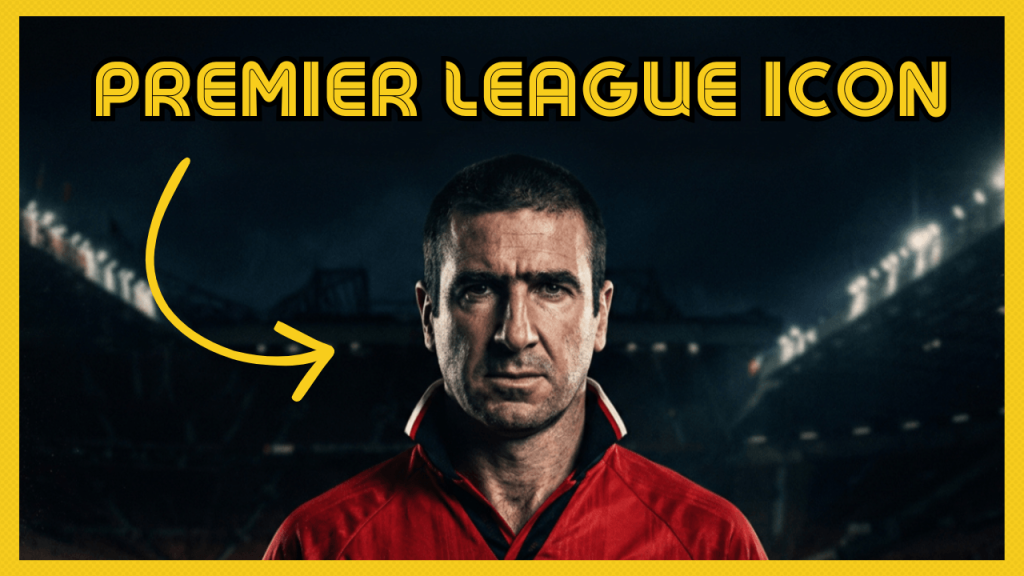
Eric Cantona: The Football Maverick Who Burned Bright, Kicked a Fan, and Won Everything, Then Walked Away at 30
He grew up watching football at the Vélodrome, perched on his father’s shoulders. He retired before he turned thirty-one. In between, he got banned by almost every club he played for, called his international manager ‘a bag of shit’ on live television, kung-fu kicked a supporter mid-match at a Premier League ground, and delivered the most baffling post-match press conference in football history. He also won six league titles and transformed Manchester United from a club haunted by twenty-six years of failure into the most dominant side in English football.
This is the full story of Eric Cantona, the Football Maverick who never ran from who he was, whose chaos and genius were inseparable, and whose career in England lasted less than five years and felt like a lifetime.
Watch the Cantona Documentary
Eric Cantona: The Poet, The Player, The Icon
Key Facts
Quick context before you watch:
- Born: 24 May 1966, Marseille, France
- Clubs: SO Caillolais (youth) → Auxerre → Martigues (loan) → Marseille → Bordeaux (loan) → Montpellier (loan) → Nîmes → Leeds United → Manchester United
- Manchester United: 82 goals in 185 appearances | 4 Premier League titles | 2 FA Cups | 2 Doubles
- International: 45 caps, 20 goals for France, never played in a World Cup
- League Titles: Won a league title in seven of his last eight full seasons as a professional (the exception: 1994-95, when banned for eight months)
- Transfer Fee: The actual Leeds-to-United transfer fee was £1m, publicly stated at £1.2-1.6m at Leeds’ request, confirmed by Man Utd chairman Martin Edwards
- Fan Favourite: Voted Manchester United’s greatest-ever player by Inside United magazine in 2003
- End of Career: Retired at 30, told Ferguson the passion had ‘gone like a light switch’
Watch the Cantona Documentary
Eric Cantona: The Poet, The Player, The Icon
Marseille, the Vélodrome, and the Boy Who Played as a Goalkeeper
Eric Daniel Pierre Cantona was born on 24 May 1966 in Marseille, into a working-class family with vivid roots on both sides of the Mediterranean. His maternal grandfather, Pere Raurich, was Catalan-Spanish, a man who had fought against Franco’s armies in the Spanish Civil War and retreated to France for medical treatment, eventually settling in Marseille and never leaving. His father Albert was a nurse and a painter. The household was animated, diverse, and saturated with the kind of strong opinion that Eric would inherit wholesale.
Marseille in the 1960s and 1970s was a football city in the way few places in France were: passionate, proud, and built around the Stade Vélodrome with a tribal intensity that shapes children before they can articulate why. Cantona has described watching football at the Vélodrome as a defining memory, his father lifting him onto his shoulders in the stands as a great side moved below them. Whether the player he remembered most vividly was Cruyff (as some accounts have it) or another, the emotional reality of that memory was consistent: it was the moment football became something he had to do.
He started at SO Caillolais, a local club whose previous products included Jean Tigana and Christophe Galtier. He played, initially, as a goalkeeper, following his father’s position. The creative instinct overruled the instruction quickly, and he moved forward. Over 200 appearances for Caillolais as a child. At fifteen, he was spotted by Auxerre and the serious business began.
Auxerre and Guy Roux: The Making of a Maverick
Guy Roux was one of the most remarkable figures in French football, a manager who spent five decades at a single provincial club, who understood football as a community undertaking and who produced players of extraordinary quality from a city of just 40,000 people. Roux also understood Cantona in a way that many who followed him would not. He saw talent and volatility as two sides of the same coin, and managed accordingly.
Cantona’s debut for Auxerre came on 5 November 1983, in a 4-0 victory over Nancy, aged seventeen. The years at Auxerre were formative in ways that stretched beyond football. National service interrupted his progress in 1984. The talent was indisputable, scoring goals at a rate that earned him European football, including a decisive equaliser from 25 yards that secured Auxerre’s continental place one season. But the character was already forming in its most complete shape: brilliant in the big moment, combustible in the quiet ones.
A punch thrown at a teammate in 1987. A dangerous kung-fu tackle on Nantes’ Michel Der Zakarian the following year, a three-month ban initially, reduced to two after Auxerre threatened to make him unavailable for the national team. The suspensions were signals that the football authorities were beginning to notice a pattern. Roux managed that pattern with patience and intelligence. Nobody who followed Roux managed it half as well.
In 1988, Cantona was part of the France under-21 side that won the European Championship, a tournament in which he scored a hat-trick against England’s under-21s in the quarter-final. That summer came the move to Marseille for what was then a record fee in French football, around FF22 million. The boy who had watched the Vélodrome from his father’s shoulders was going home. Almost nothing went right.
Watch the Cantona Documentary
Eric Cantona: The Poet, The Player, The Icon
The French Years: Banned, Loaned, Retired at 24, and Back Again
Marseille, the Torpedo Moscow Incident, and the Henri Michel Ban
The move to Marseille should have been the culmination of everything. Instead it became the first act of a protracted implosion. The problems began almost immediately. In January 1989, during a friendly against Torpedo Moscow, Cantona was substituted. He kicked the ball into the crowd. Then he pulled off his shirt and threw it away. Marseille banned him for a month.
Far more damaging had already happened. The previous September, dropped from the French national squad by manager Henri Michel, Cantona had given a post-match interview for his club Auxerre in which he described Michel as ‘a bag of shit’ on television. The phrase (‘un sac à merde’ in its original form) was broadcast in full to a football public that was beginning to form a settled view of the young striker. Henri Michel immediately handed Cantona an indefinite international ban. France subsequently failed to qualify for the 1990 World Cup, Michel was sacked, and his replacement, Michel Platini (one of Cantona’s great advocates) immediately reinstated him. But the pattern was now visible to everyone.
Bordeaux, Montpellier, and the Boots in the Face
Marseille, tired of the incidents, sent him on loan. First to Bordeaux, where he scored 6 goals in 11 league games and showed what was possible when the football was the focus. Then to Montpellier, for a full season. The football was good: 10 goals in 33 matches, and instrumental in winning the 1990 French Cup, a genuine achievement for a provincial side. But then: a dressing room fight with teammate Jean-Claude Lemoult, during which Cantona threw his boots into Lemoult’s face.
Six Montpellier players formally demanded that Cantona be sacked. The intervention of teammates (Laurent Blanc, later a World Cup winner and France manager, among them) saved him, according to accounts including Cantona’s own. He was banned from the training ground for ten days and kept on the books. The cup was won. Marseille, impressed enough by the form, took him back.
Back at Marseille, Then Nîmes, Then the Committee of Idiots
The second stint at Marseille began promisingly under coach Gérard Gili and his successor Franz Beckenbauer. It soured when chairman Bernard Tapie (one of French football’s great showmen and eventual fraudsters) replaced Beckenbauer with Raymond Goethals. Cantona and Goethals could not co-exist. Despite helping the side win the French Division 1 title in 1990-91, he was sold to Nîmes the following season.
At Nîmes, in December 1991, a referee made a decision Cantona disagreed with. He threw the ball at the referee. The French Football Federation summoned him to a disciplinary hearing and issued a one-month ban. Cantona appeared before the committee in person. Then he walked up to each member in turn and called them an idiot. The ban was doubled to two months. Cantona announced his retirement from football. He was twenty-four years old.
He went skiing.
Two people brought him back: Michel Platini, by now the godfather of his career, who made calls on his behalf and arranged the move to England; and, according to Cantona’s own account, his psychoanalyst, who advised him specifically not to sign for Marseille again and to try a different country entirely. The advice was taken. The question was which country, and which club.
Watch the Cantona Documentary
Eric Cantona: The Poet, The Player, The Icon
England Calling: Sheffield Wednesday, Liverpool, and the Leeds Rescue
Platini had conversations with clubs. He spoke to Graeme Souness at Liverpool, who declined, citing concerns about dressing room harmony, a calculation that would come to look increasingly peculiar in retrospect. He arranged a trial at Sheffield Wednesday. Cantona trained well, impressed Trevor Francis, and was offered a place. Sheffield Wednesday could not afford his wages. He prepared to return to France.
Then Howard Wilkinson at Leeds United called. Wilkinson had also heard from Platini: ‘He could be very difficult to handle, but he has the potential to be a great player’ was the endorsement, as recalled later by Leeds’ managing director Bill Fotherby. Leeds were in the middle of a title race. They needed a creative spark against tiring defences. They could afford him.
Cantona joined in February 1992 on loan from Nîmes (£100,000 loan fee), with Leeds paying a further £900,000 for a permanent transfer if they kept him beyond April. Wilkinson’s instruction was specific: he was not to start most games. He was to come on when opposing defences were tired. The approach was efficient. The fit was uneasy from the first day.
Leeds United: The Title, the Charity Shield Hat-Trick, and the Exit
Fifteen Games and a Title
In fifteen league appearances, Cantona scored three goals and provided the kind of unpredictability Leeds needed to stay clear of Manchester United in the final weeks of the last Football League First Division season. He scored his first in a 2-0 win over Luton Town and set up Lee Chapman’s twentieth league goal of the season, the sort of contribution that keeps defences guessing. Starting from the Chelsea match in April, Leeds went unbeaten in their final five games and secured the title on the penultimate weekend.
That summer, with the squad missing several key players, Cantona produced what should have been his calling card, a hat-trick in the 1992 Charity Shield, as Leeds beat Liverpool 4-3. It was the first hat-trick in the Charity Shield since 1957. The performance announced that here was a player who did his best work when the stakes were highest. It was, viewed in hindsight, a perfect farewell to Leeds supporters who had never quite got what they were dealing with.
The Misfit Season and the Faxed Transfer Request
The 1992-93 season, the first Premier League campaign, exposed the fundamental incompatibility between player and manager. Howard Wilkinson ran his squad on organisation, physical intensity, and positional discipline. Cantona played in colours rather than straight lines. Wilkinson never settled on a position for him: he floated between second striker, wide forward, and central option, the role shifting week to week in a way that prevented him building any rhythm.
Leeds’ early exit from the European Cup to Rangers compounded the tension. By November, with his place in the side uncertain, Cantona was dropped citing a ‘groin strain’, a cover story that fooled nobody, least of all Cantona. He refused to train. On 24 November 1992, he faxed a transfer request to the club, stating a preference for Manchester United, Liverpool, or Arsenal.
Leeds contacted Manchester United about Denis Irwin, the right-back they wanted to sign. United’s chairman Martin Edwards told them Irwin was not for sale, then, in a moment of improvisation, asked whether Leeds would sell Cantona instead. The answer was immediate. Leeds wanted shot of him. The fee was £1 million, lower than reported, because Leeds asked United to publicly state £1.2 to £1.6 million ‘to appease their fans.’ Edwards, in his memoirs, confirmed the actual figure was £1m. On 26 November 1992, the transfer was done.
Manchester United: The Phone Call That Changed English Football
Arrival at Old Trafford
Alex Ferguson’s United were nine points behind league leaders Norwich City when Cantona arrived. They had signed Dion Dublin in the summer, who had been injured early. Attempts to sign Alan Shearer had failed. Attempts to sign David Hirst had failed. The gap in the squad (the difference between a competent and a transcendent side) was obvious to everyone at the club.
Cantona could not register in time to play in United’s win at Arsenal on 28 November; instead he watched from the stands at Highbury as his new team secured a vital result. His debut came four days later in a friendly against Benfica in Lisbon, marking Eusébio’s fiftieth birthday. His first Premier League appearance followed almost immediately: at half-time of the Manchester derby, he came on and United beat City 2-1. His first league goal came at Stamford Bridge.
The transformation was almost instantaneous. Paul Ince recalled it with simplicity: ‘He just had that aura and presence. He took responsibility away from us. It was like he said: I’m Eric, and I’m here to win the title for you.’ Ferguson put it in structural terms: Cantona ‘swaggered in, stuck his chest out, raised his head and surveyed everything as though he were asking: I’m Cantona. How big are you?’
United lost just two league games from that point onwards and won the first ever Premier League title by a margin of ten points. The wait since 1967 was over.
1993-94: The First Double in United’s History
The following season brought an historic achievement, the first Double in Manchester United’s history, combining the Premier League title and the FA Cup in a single season for the first time. No United side had ever done it. Cantona scored 18 league goals (25 in all competitions) and was named PFA Players’ Player of the Year, the ultimate peer recognition in English football. He scored both penalties in the FA Cup final victory over Chelsea at Wembley, completing a landmark for the club and a personal statement about whose side history was on.
He was, by this point, the most important player at the most important club in English football, wearing the No. 7 shirt and turning his collar up in a gesture that became as recognisable as the shirt itself. The image of Cantona (collar raised, chest out, an unhurried master of a game’s tempo) was inseparable from the idea of a new kind of Premier League. He had introduced something English football had not quite seen before: the idea that a centre-forward could be a conductor, could operate in the space between the lines, could be simultaneously the most dangerous and the most intelligent player on the pitch.
Watch the Cantona Documentary
Eric Cantona: The Poet, The Player, The Icon
The Kung-Fu Kick: Selhurst Park, 25 January 1995
Manchester United were at Selhurst Park on a Wednesday night in January 1995, chasing league leaders Blackburn and facing a Crystal Palace side deep in a relegation battle. Crystal Palace manager Alan Smith had told his defender Richard Shaw to mark Cantona ‘like a rash.’ The instruction was effective. Cantona’s frustration was visible throughout the first half.
In the forty-eighth minute, Cantona kicked out at Shaw and was shown a red card by referee Alan Wilkie, his fifth dismissal for United, his first in six months. It was a poor challenge, the kind he had made before. What happened next had never happened before.
As Cantona was escorted along the touchline towards the dressing room by United’s kitman Norman Davies, he walked past a section of Crystal Palace supporters. One of them (Matthew Simmons, twenty years old) ran down from his seat in the stand to the front rail and taunted him. The precise words remain contested: Simmons later claimed he had said ‘Off, off, off, it’s an early bath for you, Mr Cantona.’ Cantona claimed Simmons had said ‘Fuck off back to France, you French bastard,’ called him a ‘French animal’ and his mother a ‘French whore.’
Whatever was said, Cantona pulled free from Davies and launched himself feet-first over the advertising hoardings in a full kung-fu kick that connected with Simmons’ chest. He then threw a flurry of punches before Davies and goalkeeper Peter Schmeichel (who had sprinted the length of the pitch) managed to drag him away. John Salako, then on the pitch for Palace: ‘I saw him confronting the crowd and then he just launched into this kung fu kick. It was the most surreal, amazing thing I’d ever seen, just like an out-of-body experience.’
Ferguson’s response in the dressing room at full time: the door came off its hinges. By the following morning the story was everywhere. Manchester United suspended Cantona for the remainder of the season. The Football Association extended the ban to eight months and fined him £10,000. Cantona pleaded guilty to common assault and was initially sentenced to two weeks in prison. On appeal, the jail sentence was reduced to 120 hours of community service. He spent those hours coaching football skills sessions for children at Manchester United’s training ground.
Matthew Simmons attended court during the proceedings. When his own penalty (a £500 fine and a year-long stadium ban for threatening behaviour) was announced, he leapt over a bench and attacked the prosecutor, Jeffrey McCann, who was attending his final case before retirement. Simmons was jailed for a week.
United, without Cantona for the remaining months of the season, were pipped to the title by Blackburn Rovers by a single point. Many (Ferguson included) believed Cantona’s absence cost them a third consecutive championship. It is an impossible counterfactual to resolve, but not an unreasonable one.
The Seagulls Press Conference
Following the appeal hearing at Croydon Crown Court (where his prison sentence was replaced by community service) Manchester United’s legal advisor Maurice Watkins wanted Cantona to make a public statement. Cantona did not want to speak. Watkins insisted. The two men, along with United’s head of security Michael ‘Ned’ Kelly, sat in a hotel room and worked out what Cantona would say. Kelly was asked: what’s another word for a fishing boat? What birds fly over the sea? What small fish are there? The answers (trawler, seagulls, sardines) were assembled.
Cantona walked to the microphone. He paused. He took a dramatic sip of water. He said: ‘When the seagulls follow the trawler, it is because they think sardines will be thrown into the sea.’ He stood up and left. From the room packed with journalists, one voice could be heard above the confused murmur: ‘Seagulls?’
The press spent years analysing it as a philosophical statement. French existentialism was invoked. Camus was referenced. The actual explanation, which Cantona gave publicly in 2024, was both simpler and more perfectly Cantona: ‘They wanted me to speak. I spoke. It just came out. And the press, they all tried to find a sense to it.’ He added, with evident satisfaction, that he had had his revenge: ‘they were all trying to find a meaning and they all asked me to explain and I said nothing.’
Gordon Strachan, who had played alongside him at Leeds, offered the most economical commentary: ‘If a Frenchman goes on about seagulls, trawlers and sardines, he’s called a philosopher. I’d just be called a short Scottish bum talking crap.’
The Return: Newcastle’s 12-Point Lead and the Double
Cantona served his ban. He returned to first-team football on 1 October 1995, at home against Liverpool, scoring a late penalty in a 2-2 draw. The return was greeted at Old Trafford the way a returning monarch is greeted. The Premier League had started a new season without him and Newcastle United, under Kevin Keegan, had built what appeared to be an insurmountable advantage.
By January 1996, Newcastle led the table by twelve points. Alan Shearer, Les Ferdinand, and David Ginola had made them the most exciting attacking side in England. Alan Hansen, on the opening day’s Match of the Day, had already delivered his verdict on the young United side that had lost 3-1 at Aston Villa: ‘You can’t win anything with kids.’
Cantona, returned and playing with authority that suggested eight months of enforced absence had sharpened rather than dulled him, became the axis around which the comeback was built. The decisive moment came at St James’ Park on 4 March 1996. Newcastle led United by four points with a game in hand. Newcastle had not lost at home all season. Cantona scored the only goal of the game in the second half (an composed finish from an Andy Cole knock-down) and the lead was cut to a single point. From that night onwards, Newcastle’s belief evaporated. Kevin Keegan’s famous, anguished ‘I would love it if we beat them’ interview became the defining image of a title race that had already been decided by the time the words were spoken.
United won the league. Six days later, at Wembley, they won the FA Cup final 1-0 against Liverpool. With five minutes remaining, a David James punch from a corner dropped to the edge of the penalty area. Cantona struck it through the crowd of players and into the net. United became the first club in history to win the Double twice. Cantona was named Football Writers’ Association Player of the Year, just a year after the player most newspapers had declared finished.
Watch the Cantona Documentary
Eric Cantona: The Poet, The Player, The Icon
The Final Season, the Captaincy, and the Sudden Retirement
For 1996-97, Cantona was named United captain. The season brought a fourth Premier League title in five years. It also brought a Champions League semi-final, a run that ended in two 1-0 defeats to Borussia Dortmund, the eventual winners of the competition. Cantona, who never won the European Cup, found Europe consistently elusive throughout his career in a way that nothing else in the game had been.
In the days following the second leg at Old Trafford, Cantona told Ferguson he was retiring at the end of the season. Ferguson tried everything: persuasion, time, space, the argument that there were years left. Cantona was immovable. His teammates did not know. Solskjaer and Jordi Cruyff, celebrating the title win at four in the morning, said their goodbyes and caught a train to London. They heard on the radio, as they stepped off the train, that Cantona had retired. He had said nothing the entire night.
The retirement announcement came on 18 May 1997. Cantona was not present. The statement was short: ‘I have played professional football for thirteen years, which is a long time. I now wish to do other things. I always planned to retire when I was at the top and, at Manchester United, I have reached the pinnacle of my career.’
Years later, he explained it with the same clarity: ‘I was very passionate about the game and I always said that when I lost that passion, I would retire. When I lost that passion, I retired. No regrets. The passion just went like a light switch. I waited and said to myself, it will come back, it will come back, but it never came back, so I retired.’
Ferguson replaced him with Teddy Sheringham, who went on to score the equaliser in the 1999 Champions League final. The generation Cantona had helped shape (Giggs, Scholes, Beckham, the Neville brothers, Butt) won the Treble two seasons after he left. He had done his work.
The France Career: Brilliance, Catastrophe, and Zidane’s Shadow
Eric Cantona won 45 caps for France and scored 20 goals, a record that, by any objective measure, represents a fine international career. It does not represent what his talent warranted, and the gap between what he achieved at club level and what he achieved internationally is one of the defining frustrations of his story.
His full debut came against West Germany in August 1987. He was already in trouble within a year. In September 1988 (dropped from the squad) he called manager Henri Michel a ‘bag of shit’ in a post-match television interview. The ban was indefinite. It lasted until Michel was sacked (France having failed to qualify for the 1990 World Cup) and Michel Platini, Cantona’s greatest advocate, took over.
Under Platini, France qualified for Euro 1992. They played in Sweden and failed to win a single match. Platini resigned. Under Gérard Houllier, the qualification campaign for the 1994 World Cup became a national catastrophe. On the final qualifying night (17 November 1993, at the Parc des Princes in Paris) France needed only a draw against Bulgaria to reach the tournament. Cantona gave them the lead. Then Emil Kostadinov scored twice in the final two minutes to send Bulgaria through. Houllier singled out David Ginola’s late cross (which led to the Bulgarian counter) as the pivotal error. Cantona, having scored the goal that looked like it would be enough, watched the qualification collapse around him.
France did not go to the 1994 World Cup. Cantona, named France captain by new manager Aimé Jacquet ahead of the preparations for Euro 96, then had his captaincy stripped following Selhurst Park. During his eight-month ban, Jacquet rebuilt the side around a younger generation. Zinedine Zidane, who had quietly been accumulating quality in the background, stepped into the space. By the time Cantona returned to club football (brilliant, FWA Player of the Year, Double winner) Jacquet had decided to move on. Cantona was never recalled by France.
France reached the semi-final of Euro 96, losing to Czech Republic on penalties. Two years later, they hosted and won the World Cup, Zidane’s tournament, built on the defensive organisation Jacquet had constructed in Cantona’s absence. Cantona watched from retirement. He said, years later, that if he had still been involved with France, he would not have retired in 1997 and would have extended his career to play in the 1998 tournament. History did not give him the chance to find out.
Legacy: King Eric in the Premier League Era
What Cantona did for Manchester United between November 1992 and May 1997 is documented in the trophy cabinet: four Premier League titles, two FA Cups, two Doubles. The statistics (82 goals in 185 appearances) do not tell the full story, because the full story is not about goals alone.
Ferguson, who did not deal in hyperbole lightly, wrote in his autobiography: ‘I don’t mean to demean or criticise any of the great or very good footballers who played for me during my 26-year career at United, but there were only four who were world class: Cantona, Giggs, Ronaldo and Scholes.’ The company is the measure.
What Cantona changed at United was the culture. Ryan Giggs reflected it explicitly: ‘Gary and Phil Neville, Nicky Butt, Paul Scholes, David Beckham and myself, we all followed his lead.’ Roy Keane, in his autobiography, described it from inside the dressing room: ‘Collar turned up, back straight, chest stuck out, Eric glided into the arena as if he owned the place.’ The Michael Browne painting (Cantona as a Christ figure, with the Class of 92 as his apostles, currently on loan to the National Football Museum from the Cantona family) captures something that felt grandiose as a concept and accurate as a description of the power dynamic.
What Cantona changed for the Premier League was harder to quantify but equally real. He arrived at the precise moment the new competition was establishing its identity. He was the first player of genuine continental stature to commit to it as a destination rather than a curiosity. The collar-up image, the sorcerer’s footwork, the unpredictability: Cantona made the Premier League feel like the place where great players came because they wanted to, not because they had exhausted the alternatives. The league was different for his presence in it.
He never won the Champions League. He never played in a World Cup. He retired at thirty. He was voted Manchester United’s greatest-ever player by the club’s own magazine in 2003 and the club’s Player of the Century in a fan poll in 2001. He would, by the way he departed (on his own terms, at the top, because the passion had left and he refused to continue without it) have considered every one of those awards secondary to the fact of leaving while he still could.
The seagulls will always follow the trawler.
Watch the Cantona Documentary
Eric Cantona: The Poet, The Player, The Icon
Frequently Asked Questions (FAQs)
What clubs did Eric Cantona play for?
Eric Cantona’s professional career took him through: SO Caillolais (youth), Auxerre (1983-88, with a loan spell at Martigues), Marseille (1988-91, with loans at Bordeaux and Montpellier), Nîmes (1991), Leeds United (1992-93), and Manchester United (1992-97). He also played for and managed the France national beach soccer team after retiring from the professional game.
Why was Cantona so controversial in France before coming to England?
Cantona accumulated a series of disciplinary incidents across multiple clubs in France that established his reputation for volatility. These included punching a teammate at Auxerre, a dangerous tackle on a Nantes player resulting in a ban, kicking the ball into the crowd and throwing his shirt during a Marseille friendly, throwing his boots at Montpellier teammate Jean-Claude Lemoult, calling France manager Henri Michel ‘a bag of shit’ on television (earning an indefinite international ban), throwing the ball at a referee at Nîmes, then calling each member of his disciplinary committee an idiot, doubling his ban. He subsequently announced his retirement at twenty-four before being persuaded to go to England.
How did Cantona end up at Leeds United?
Following his retirement announcement after the Nîmes incidents, Michel Platini (then France manager and one of Cantona’s strongest advocates) approached clubs on his behalf. Liverpool’s Graeme Souness declined, citing dressing room concerns. Sheffield Wednesday offered a trial that went well but could not afford his wages. Howard Wilkinson at Leeds United had heard Platini’s recommendation and needed a creative spark in a tight title race. Cantona joined in February 1992 on loan from Nîmes, initially for a £100,000 loan fee, with Leeds paying a further £900,000 for a permanent transfer.
What did Cantona achieve at Leeds United?
Cantona made fifteen league appearances for Leeds in the second half of the 1991-92 season, scoring three goals and providing several important assists as Leeds won the final Football League First Division title before it was replaced by the Premier League. That summer, in the 1992 Charity Shield, he scored a hat-trick as Leeds beat Liverpool 4-3, the first Charity Shield hat-trick since 1957. His debut Premier League season (1992-93) was less successful: a poor fit with Wilkinson’s system, a disputed ‘groin strain’ excuse for being dropped, and a faxed transfer request ended his Leeds career after a single Premier League campaign.
How did Cantona move from Leeds to Manchester United?
Leeds United’s managing director Bill Fotherby phoned Manchester United chairman Martin Edwards in November 1992 to enquire about signing right-back Denis Irwin. Edwards told him Irwin was not for sale, then immediately asked whether Leeds would sell Cantona. Wilkinson agreed almost at once, having decided the relationship was irreparable. The real fee was £1 million, though Leeds asked United to publicly state a higher figure to protect their standing with fans. Edwards confirmed the actual figure in his memoirs. The transfer was completed on 26 November 1992.
What happened at Selhurst Park in January 1995?
On 25 January 1995, playing for Manchester United at Crystal Palace, Cantona was sent off in the forty-eighth minute for kicking out at defender Richard Shaw. As he was escorted along the touchline by kitman Norman Davies, Palace supporter Matthew Simmons ran to the front of the stand and taunted him. Cantona pulled free from Davies and launched a two-footed kung-fu kick at Simmons, then threw punches before being restrained by Davies and goalkeeper Peter Schmeichel. Cantona received an eight-month ban from football and 120 hours of community service after his two-week prison sentence was reduced on appeal.
What did Cantona say at the seagulls press conference?
At the press conference following the appeal hearing at Croydon Crown Court (which replaced his prison sentence with community service) Cantona approached the microphone, paused, took a sip of water, and said: ‘When the seagulls follow the trawler, it is because they think sardines will be thrown into the sea.’ He then stood up and left. The line had been assembled in a hotel room beforehand, with United’s head of security Michael Kelly supplying the words ‘trawler,’ ‘seagulls,’ and ‘sardines.’ Cantona confirmed in 2024 that it was improvised under pressure and designed to give the press nothing useful: ‘You make me speak, I speak, and who cares whether the words make sense.’
How did Manchester United win the 1995-96 title after being 12 points behind Newcastle?
Cantona returned from his eight-month ban on 1 October 1995. Newcastle United had built a twelve-point lead by January 1996. United gradually closed the gap through a run of consistent narrow victories, several won by Cantona goals. The decisive match came at St James’ Park on 4 March 1996: Cantona’s second-half goal gave United a 1-0 win, cut the lead to a single point, and ended Newcastle’s belief. Newcastle subsequently dropped points; United won their remaining games; and the title was settled on the final day, United winning 3-0 at Middlesbrough. Six days later, Cantona scored the FA Cup final winner against Liverpool, completing United’s second-ever Double.
Why did Cantona retire so early at the age of 30?
Cantona retired at thirty because, in his own words, the passion for football had left him ‘like a light switch.’ In the days following United’s Champions League semi-final exit to Borussia Dortmund, he told Ferguson he would not continue. He had always said publicly he would retire the moment the passion disappeared. ‘I waited and said to myself, it will come back, it will come back, it will come back, but it never came back, so I retired.’ He also said he could have played another decade physically, but felt it would be dishonest to continue at the level United demanded without the internal fire that had driven him there.
How many Premier League titles did Cantona win with Manchester United?
Cantona won four Premier League titles with Manchester United: 1992-93, 1993-94, 1995-96, and 1996-97. He also won the Football League First Division title with Leeds United in 1991-92, giving him five English league titles across his career. Including the French Division 1 title won with Marseille in 1990-91, Cantona won six league titles in total and won a league championship in seven of his last eight full professional seasons, the exception being 1994-95, when he served an eight-month ban following the Selhurst Park incident.
Why did Cantona never play in a World Cup?
Cantona never played in a World Cup due to a combination of team failure, personal controversy, and being replaced in the France setup by Zinedine Zidane. France failed to qualify for the 1990 World Cup (Cantona had been banned for calling manager Henri Michel ‘a bag of shit’). France failed to qualify for the 1994 World Cup after losing their final qualifier to Bulgaria, Cantona having given them the lead before Kostadinov scored twice in the final two minutes. The 1995 Selhurst Park ban cost him the France captaincy; during those eight months, Jacquet rebuilt the side around Zidane. Cantona was never recalled. France won the 1998 World Cup without him.
What was Eric Cantona’s international record for France?
Eric Cantona made 45 appearances for France and scored 20 goals, a solid international record that understates what should have been a more decorated career. He was given the France captaincy by manager Aimé Jacquet ahead of Euro 96 preparations, but lost it following the Selhurst Park ban. During his suspension, Zinedine Zidane replaced him as the team’s creative fulcrum. Cantona was never recalled by Jacquet and never played for France again after January 1995.
What was Cantona’s relationship with Alex Ferguson like?
By most accounts, Cantona’s relationship with Ferguson was the most significant managerial relationship of his career, and one that worked precisely because Ferguson offered latitude that no previous manager had given him. Where Howard Wilkinson demanded positional discipline, Ferguson gave Cantona freedom within a structure. Ferguson described Cantona as one of only four world-class players he worked with in twenty-six years at United. After Cantona’s retirement, Ferguson wrote him a personal letter (later published) expressing his admiration and sadness at the departure. Cantona, in turn, has spoken about Ferguson with respect and affection that he extends to very few authority figures in his life.
Who was Matthew Simmons and what happened to him?
Matthew Simmons was the Crystal Palace supporter who ran to the front of the stand to taunt Cantona at Selhurst Park on 25 January 1995. He later claimed he had said ‘Off, off, off, it’s an early bath for you, Mr Cantona.’ Cantona maintained Simmons had used racist and abusive language. Simmons was charged with threatening behaviour, fined £500, and given a year-long stadium ban. At his own court hearing, when the verdict was announced, he leapt over a bench and attacked the prosecutor, Jeffrey McCann, who was attending his final case before retirement. Simmons was jailed for a week for that assault. Media reporting later identified Simmons as a former attendee of far-right political rallies, and the incidents continued to follow him.
What trophies did Cantona win across his career?
Cantona won six league titles across his career: the French Division 1 in the 1990-91 season with Marseille, the Football League First Division in 1992 with Leeds United, and four Premier League titles with Manchester United (1993, 1994, 1996, 1997). He also won two FA Cups with Manchester United (1994 and 1996), completing two Doubles. He won the French Cup with Montpellier in 1990. At youth level he won the 1988 UEFA European Under-21 Championship with France, scoring a hat-trick against England U21s in the quarter-final. At senior international level he played in UEFA Euro 1992 but France were eliminated in the group stage without winning a match.
What was the actual transfer fee Manchester United paid Leeds for Cantona?
The actual fee Manchester United paid Leeds United for Cantona was £1 million. The publicly stated figure at the time was £1.2 million, or, in some reports, £1.6 million. According to Manchester United chairman Martin Edwards, confirmed in his memoirs, Leeds asked United to announce a higher figure ‘to appease their fans,’ who would be less upset by the sale to fierce rivals if they believed the fee was substantial. Edwards agreed. The actual fee was £1 million, making the transfer one of the most consequential bargains in football history.
Did Cantona ever play in the Champions League?
Yes, Cantona played in the Champions League with Manchester United across three seasons (1993-94, 1994-95, and 1996-97). His record in Europe was significantly less successful than his domestic output: United were knocked out by Galatasaray in 1993-94, eliminated in the group stage in 1994-95, and beaten in the semi-finals by Borussia Dortmund (the eventual winners) in 1996-97. Cantona scored relatively few European goals and it remains the significant gap in his career CV. He never won the Champions League. United won it in 1999, two years after he retired.
What did Cantona do after retiring from football?
After retiring from professional football in 1997, Cantona turned to acting, appearing in the 1998 historical drama Elizabeth (with Cate Blanchett) and the 2009 Ken Loach film Looking for Eric, in which he played a fictionalised version of himself appearing to a Manchester United fan as a hallucination. He also became player-manager of the French national beach soccer team, winning the 2005 FIFA Beach Soccer World Cup. In 2011 he was appointed Director of Soccer at New York Cosmos, a post that ended after a confrontation with a photographer. In 2023 he released his debut music single and performed a UK tour. He has remained publicly active, occasionally speaking on football matters and continuing to confound expectations.
What is Eric Cantona’s legacy at Manchester United?
Cantona’s legacy at Manchester United is that of the catalyst, the player who turned a competitive side into a dominant one and who set the cultural template for everything that followed. He was voted Manchester United’s greatest-ever player by Inside United magazine in 2003 and the club’s Player of the Century in a fan poll in 2001. Alex Ferguson named him as one of four world-class players across his entire twenty-six-year United tenure. He wore the iconic No. 7 shirt, turned his collar up, and in 185 appearances scored 82 goals and won four league titles and two FA Cups. He was inducted into the English Football Hall of Fame in 2002 and named the Premier League’s Overseas Player of the Decade at the competition’s ten-year awards in 2003.
What has the Football Mavericks series covered on The Football Documentary Channel?
The Football Mavericks series on The Football Documentary Channel explores the careers of football’s most brilliant, combustible, and unconventional figures, the players who played by their own rules, rewrote what was possible, and left football permanently different from how they found it. Eric Cantona is among the series’ subjects. All documentaries are free to watch on YouTube at youtube.com/@footballdocumentaries. Subscribe to be notified when new films are published across the Football Mavericks, Football Rivalries, and Football Disasters series.
What was the Eric Cantona kung-fu kick incident?
On 25 January 1995, at Selhurst Park, Cantona was shown a red card during Manchester United’s match at Crystal Palace. As he walked toward the tunnel along the touchline, a Palace supporter named Matthew Simmons ran to the front of the stand and abused him at close range. Cantona turned, ran two steps, and launched a flying kick at Simmons, following it with punches. He was banned for eight months, ordered to complete 120 hours of community service, and faced criminal proceedings. Matthew Simmons was himself later convicted of threatening behaviour for his role in the incident.
What connection does Eric Cantona have to the seagulls and sardines quote?
The “seagulls follow the trawler” quote was Cantona’s response to a press conference held after the kung-fu kick incident, at which journalists and broadcasters were expecting either an apology or an explanation. He delivered neither, instead reading this single poetic statement, apparently comparing the media scrum to seagulls following a fishing boat in hope of scraps, before standing up and leaving. It has since become one of the most cited quotes in football history, largely because nobody is quite sure what it meant.
What does the Eric Cantona documentary on The Football Documentary Channel cover?
The TFDC documentary explores the extraordinary arc of Cantona’s career, from the turbulent French years through Leeds and the life-changing move to Old Trafford. It covers the kung-fu kick, the eight-month ban, the comeback, and the retirement at 30. It examines what Cantona meant to Manchester United and what Manchester United meant to him. It is free to watch at youtube.com/@footballdocumentaries. The full companion deep dive (covering his complete career, the Cantona philosophy, and all important FAQs) is at footballdocumentaries.com/eric-cantona/.