Last Updated: April 2026
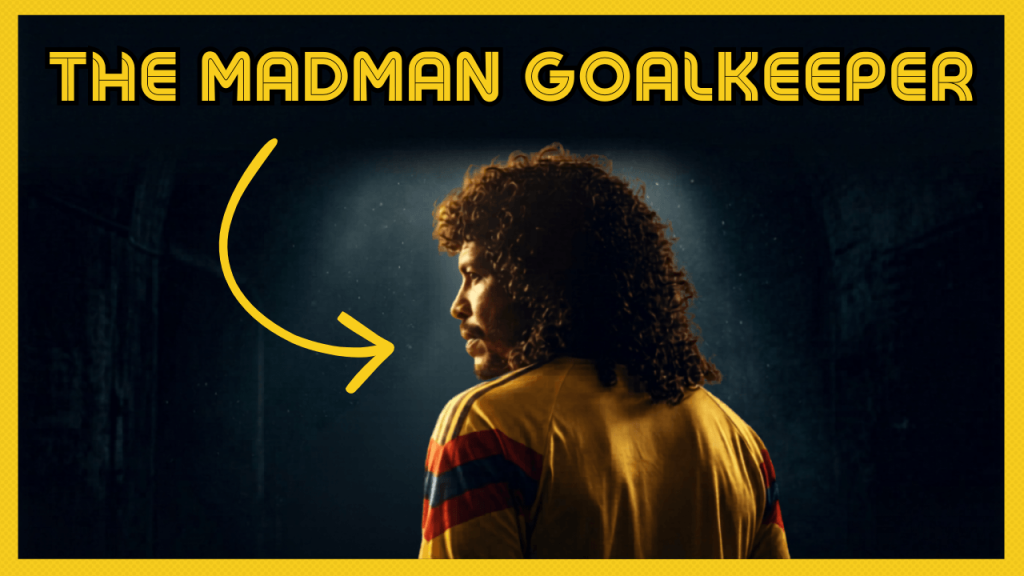
René Higuita: El Loco – The Goalkeeper Who Invented the Scorpion Kick and Changed Football Forever
There has never been a goalkeeper quite like René Higuita. Not before him. Not since. In a position defined by caution and the measured management of risk, Higuita made dribbling, free-kicks, and outfield adventures his calling card – and in doing so, accidentally rewrote the laws of the game.
José René Higuita Zapata was born on 27 August 1966 in the Castilla neighbourhood of Medellín, Colombia – a city then in the grip of the worst drug cartel violence in the western hemisphere. He came of age as an outfield player, starting his career as a striker, and only moved into goal by accident when a teammate was injured in a five-a-side game. He refused to leave behind what he had learned as a forward. The goalkeeping position became, in his hands, something entirely new.
At Atlético Nacional, his Medellín club, he was key to winning the 1989 Copa Libertadores. In one of the most dramatic finals in the competition’s history, Nacional went into the second leg against Club Olimpia of Paraguay having lost 2–0 away in Asunción. They came back, forced a penalty shootout, and Higuita saved four penalties and scored one himself to seal the first Copa Libertadores ever won by a Colombian club.
At the 1990 World Cup in Italy, Higuita lit up a drab tournament – until Roger Milla dispossessed him far outside his own penalty area in the round of sixteen, scoring into an empty goal to eliminate Colombia. “It was a mistake as big as a house,” Higuita said afterwards, and never sought to minimise it. He knew it was the price of playing the way he played.
His connection to Pablo Escobar’s Medellín Cartel orbit led to a seven-month imprisonment in 1993, after he acted as a ransom intermediary and received $64,000 in payment – illegal under Colombian law. He missed the 1994 World Cup as a result. Watching from home, he saw Colombia collapse in the group stage and his teammate Andrés Escobar murdered ten days after scoring an own goal at the tournament.
Then came Wembley. 6 September 1995. A 0-0 friendly that nobody remembers for anything else. Jamie Redknapp hit a miscued cross towards the Colombian goal. What Higuita did next – arching his body backwards and clearing with both heels simultaneously, his body forming the shape of a scorpion’s tail – became one of the most replayed moments in football history. He had been rehearsing the move for two years, inspired by watching a child kick a ball backwards in a soft drink commercial.
His legacy goes far beyond the Scorpion Kick. His style contributed directly to the 1992 back-pass rule – known in Colombia as the “Higuita Rule” – which permanently changed the pace of football. He scored 41 career goals, making him one of the ten highest-scoring goalkeepers in history. IFFHS ranked him the 8th greatest South American goalkeeper of all time.
Key Facts
Quick context before you watch:
- Full Name: José René Higuita Zapata
- Born: 27 August 1966, Castilla, Medellín, Colombia
- Nickname: El Loco (“The Madman”) – given by coach Francisco Maturana
- Career Start: As a striker; became a goalkeeper by accident in a five-a-side game as a teenager
- Copa Libertadores 1989: Won with Atlético Nacional – the first Copa Libertadores won by a Colombian club; saved 4 penalties and scored 1 in the final shootout against Club Olimpia of Paraguay
- The Scorpion Kick: 6 September 1995, Wembley, England vs Colombia friendly; clearing a Jamie Redknapp cross; rehearsed for approximately two years
- Career Goals: 41 – one of the ten highest-scoring goalkeepers in history
- The Higuita Rule: The 1992 back-pass rule – banning goalkeepers from handling deliberate back-passes from teammates – known in Colombia as “the Higuita Rule”
- Netflix Documentary: Higuita: The Way of the Scorpion (2023)
- IFFHS Ranking: 8th greatest South American goalkeeper in history
- International Career: 68 caps for Colombia (1987–1999), 3 goals
Watch the René Higuita Documentary
René Higuita – The Madman Sweeper Keeper
READ MORE: The Life and Career of René Higuita — Deep Dive →
The Copa Libertadores, Italia 90 and Wembley
Higuita’s sweeper-keeper style was not a gimmick. It was a tactical philosophy built by his coach Francisco Maturana, who described it as giving Colombia “eleven outfield players rather than ten.” Higuita dribbled into midfield, took free-kicks, and intercepted through balls that conventional goalkeepers would never have reached. It was football operating from a completely different set of assumptions.
The 1989 Copa Libertadores win was its first vindication at the highest level. The 1990 World Cup demonstrated its risks – the Roger Milla dispossession remains one of the defining cautionary moments in goalkeeping history. And the 1992 back-pass rule, introduced by FIFA partly in response to what they had seen at that tournament, made what Higuita was already doing a universal requirement for every goalkeeper in the world.
The Scorpion Kick was the theatrical coda. The moment of pure joy that could only have come from a player who had spent his entire career treating the goalkeeper position as an invitation to be creative rather than a mandate to be cautious.
Frequently Asked Questions (FAQs)
What is René Higuita’s famous Scorpion Kick save?
The Scorpion Kick is a save performed by René Higuita during an England vs Colombia friendly at Wembley Stadium on 6 September 1995. When Jamie Redknapp’s miscued cross dropped behind him, Higuita dived forward, planted both hands on the turf, and brought both heels up simultaneously over his head – his body forming the shape of a scorpion with its stinger raised – to clear the ball. It was entirely unnecessary (he could simply have caught it), had been rehearsed for approximately two years after watching a child kick a ball backwards in a Colombian soft drink commercial, and is widely considered the most audacious save ever performed at international level. The match ended 0-0. The Scorpion Kick was ranked 94th in Channel 4’s 100 Greatest Sporting Moments in 2002.
Why did René Higuita miss the 1994 World Cup?
Higuita was imprisoned from June 1993 for acting as a paid intermediary in a kidnapping case involving drug trafficker Carlos Molina. Molina asked Higuita to deliver a ransom payment, which Higuita did, receiving $64,000 – illegal under Colombian law, which prohibits profiting from a kidnapping regardless of intent or motive. He was held for seven months without formal charge and mounted a two-week hunger strike in protest. Released in January 1994 physically unfit after months without training, he was not selected for the 1994 World Cup squad.
Was René Higuita friends with Pablo Escobar?
Higuita grew up in Medellín during Escobar’s years of dominance and played for Atlético Nacional, a club that received narco-connected investment during that era. He has described Escobar as a childhood acquaintance rather than a close personal friend, noting that in Medellín of that era, Escobar’s orbit was inescapable for any footballer from the city. He was photographed outside La Catedral – Escobar’s personal mountaintop prison – and has confirmed they knew each other. His 1993 imprisonment arose directly from facilitating a ransom payment within Escobar’s network. The 2023 Netflix documentary Higuita: The Way of the Scorpion covers this relationship in detail.
What is the Higuita Rule in football?
The back-pass rule – introduced in 1992 and prohibiting goalkeepers from handling deliberate back-passes from teammates – is known in Colombia as the “Higuita Rule.” FIFA introduced it following the 1990 World Cup, which produced a record-low 2.2 goals per game amid widespread defensive play. Higuita’s sweeper-keeper style had demonstrated that a goalkeeper could use their feet to build attacks; FIFA legislated to make this universal. The 1994 World Cup, played under the new rule, averaged 2.71 goals per game – the highest since 1970.
Did René Higuita invent the sweeper-keeper position in football?
Higuita is the most significant pioneer of the modern sweeper-keeper, though he did not create the concept from nothing – Argentine goalkeeper Amadeo Carrizo played similarly at River Plate in the 1940s and 1950s. Higuita took the concept further than any goalkeeper had at a major international tournament, operating within a system specifically designed around his outfield participation. His coach Francisco Maturana described it as giving Colombia eleven outfield players. Manuel Neuer, Ederson, and Alisson – the modern exemplars of the role – play within a framework that Higuita’s career helped make standard practice.
How many goals did René Higuita score during his career as a goalkeeper?
Higuita scored 41 career goals – primarily from penalties and direct free-kicks – placing him among the ten highest-scoring goalkeepers in football history. Clubs routinely gave him set-piece duties, recognising both his dead-ball quality and the entertainment he provided. During the 1999-2000 season alone, playing for Independiente Medellín, he scored 11 goals in 20 appearances. Some sources cite 43 goals, apparently including exhibition matches; 41 is the most consistently verified figure.
What happened to Colombia at the 1990 World Cup because of Higuita?
Colombia reached the round of sixteen at Italia 90 – their first World Cup since 1962 – and faced Cameroon. With the match goalless in extra time, Higuita received the ball in his own half and attempted to dribble out, as was his custom. Veteran Cameroon striker Roger Milla, who had studied Higuita’s habit of leaving his area, closed quickly and dispossessed him with the goal empty. Milla scored. Colombia ultimately lost 2–1 and were eliminated. Higuita described it as “a mistake as big as a house” and has never sought to excuse it.
What is the Netflix documentary about René Higuita?
Higuita: The Way of the Scorpion (Spanish: Higuita: El camino del Escorpión) is a Netflix documentary released in November 2023. It covers Higuita’s upbringing in Medellín, his career at Atlético Nacional, the Escobar connection, his imprisonment, the 1994 World Cup he missed, and the Scorpion Kick. Higuita participated in the film and gave his own account of the kidnapping case and the cartel era. The TFDC documentary covers similar ground in a shorter film format, free to watch at youtube.com/@footballdocumentaries.
What clubs did René Higuita play for during his career?
In chronological order: Millonarios (Colombia, 1985-86), Atlético Nacional (Colombia, multiple spells from 1986), Real Valladolid (Spain, 1991-92), Veracruz (Mexico, 1997-99), Independiente Medellín, América de Cali, Junior de Barranquilla, SD Aucas (Ecuador, 2004), and Guaros FC (Venezuela, 2007-08). His final professional appearance was on 25 January 2010 in Medellín, aged 43. The majority of his career was at Atlético Nacional, where he remains the definitive goalkeeper in the club’s history.
Why was René Higuita nicknamed El Loco?
El Loco – “The Madman” – was the nickname given to Higuita by his Atlético Nacional and Colombia coach Francisco Maturana. It was Maturana’s affectionate description of Higuita’s high-risk, unconventional approach: dribbling into midfield, taking free-kicks, leaving his penalty area to intercept opponents far from goal. What Maturana actually believed – and stated publicly – was that Higuita’s behaviour was tactical innovation, not madness. His famous summary: with René as sweeper, Colombia had eleven outfield players rather than ten. Higuita embraced the nickname and carried it throughout his career.
What is René Higuita’s international record with Colombia?
René Higuita earned 68 international caps for Colombia between 1987 and 1999, scoring three goals. He was the first-choice goalkeeper for the Colombian generation that reached the round of sixteen at the 1990 World Cup, beat Argentina 5–0 in Buenos Aires during qualifying for USA 94, and finished third at the 1993 Copa América. He missed the 1994 World Cup through imprisonment. After his release he returned to the national team, playing in the 1995 and 1999 Copa América tournaments.
Is René Higuita considered one of the greatest goalkeepers in history?
Higuita is ranked 8th among all South American goalkeepers in history by the International Federation of Football History and Statistics (IFFHS). He is more broadly ranked among the ten highest-scoring goalkeepers in football history, with 41 career goals. Beyond statistics, his cultural and tactical legacy – pioneering the sweeper-keeper role, inspiring the back-pass rule, and performing the Scorpion Kick – makes him one of the most significant and original figures the position has ever produced.
Did René Higuita ever play in Europe?
Yes. Higuita played for Real Valladolid in La Liga during the 1991-92 season. He returned to Colombia mid-season, reportedly unsettled in Spain. Later in his career, after his post-prison return, he played in Mexico (Veracruz, 1997-99), Ecuador (SD Aucas, 2004), and Venezuela (Guaros FC, 2007-08). The Valladolid spell remained his only experience of top-flight European club football.
What did René Higuita do after retiring from football?
After his final professional appearance, Higuita moved into goalkeeping coaching. He worked at Real Valladolid in late 2008 before joining Al Nassr FC in Saudi Arabia as goalkeeping coach in 2011, remaining there until approximately 2016. In June 2017 he returned to Atlético Nacional as goalkeeping coach, describing it as “the dream of my life.” He has spoken publicly about his wish to coach the Colombia national team. He lives in Medellín and was the subject of the Netflix documentary in 2023.
What does the René Higuita documentary on The Football Documentary Channel cover?
The TFDC documentary tells El Loco’s story: from the streets of Castilla in Medellín, through the 1989 Copa Libertadores triumph, the Italia 90 drama with Roger Milla, his imprisonment in the shadow of the Escobar years, and the Scorpion Kick at Wembley in 1995. It is free to watch at youtube.com/@footballdocumentaries. The full companion deep dive at footballdocumentaries.com/rene-higuita/ covers his complete career, career statistics, and all important FAQs in detail.
The Complete René Higuita Story
The documentary is the introduction. For the complete story — the Copa Libertadores drama told chapter by chapter, the Escobar years in full, the back-pass rule legacy, career statistics, and all 20 FAQs — read the companion deep dive:
READ MORE: The Life and Career of René Higuita — Deep Dive →
Watch the René Higuita Documentary
René Higuita – The Madman Sweeper Keeper